
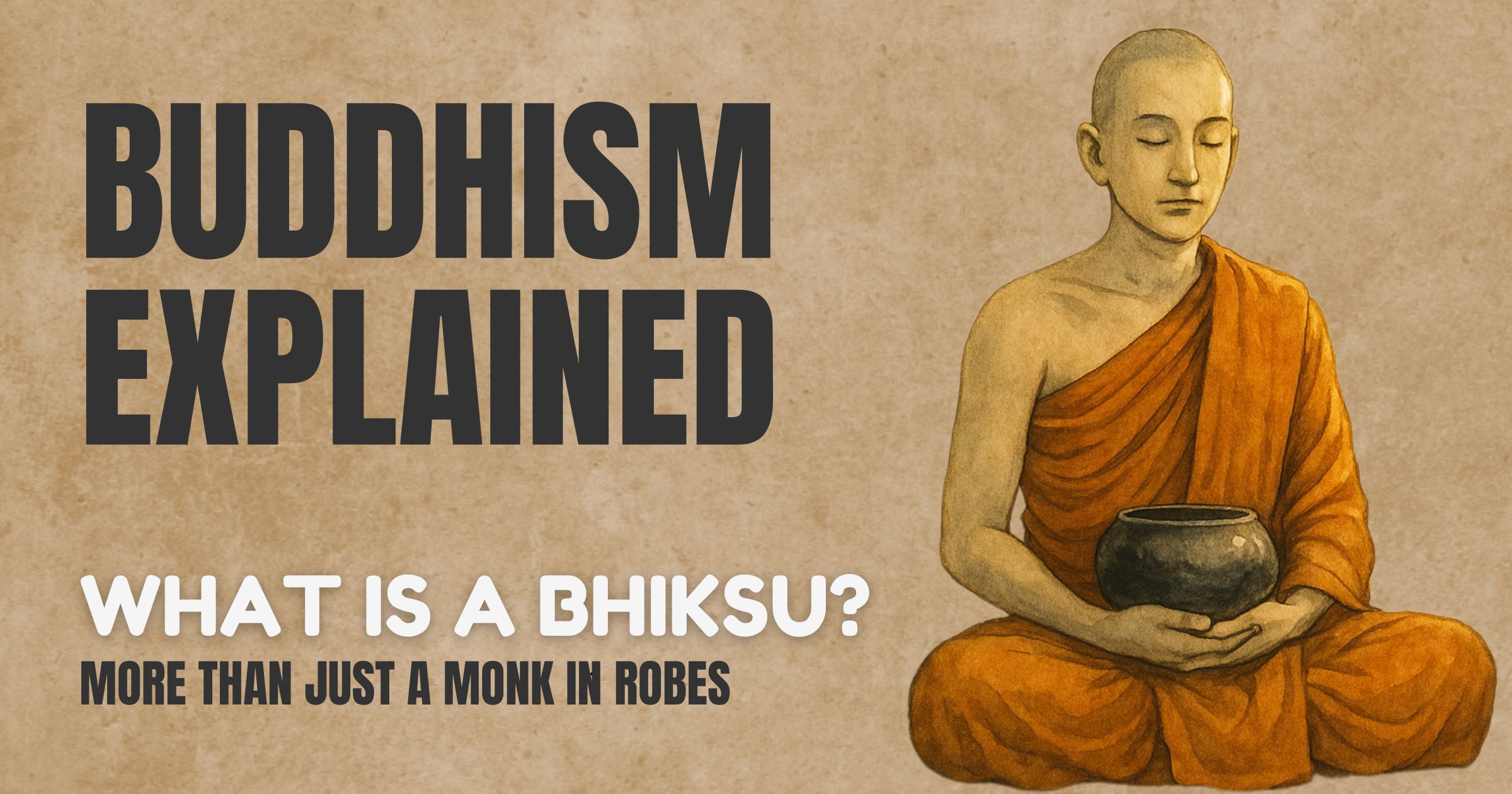
When people hear the word “monk,” they usually imagine a bald guy in orange robes meditating in a cave or wandering barefoot through a forest. And hey, that’s not wrong—but if we’re talking Buddhism, there’s a specific word for that role: Bhikṣu (比丘).
And let me tell you, it’s way more than just “a guy in robes.”
A Bhikṣu isn’t simply someone who shaved their head and left home. It’s a title loaded with meaning, commitment, history, and a whole spiritual user manual called the Vinaya—aka the rulebook of monastic life. It comes with discipline, identity, and a surprisingly long list of ancient nicknames, including some that sound like kung fu moves.
So let’s unpack what it really means to be a Bhikṣu—where the term comes from, what Bhikṣus vow to do, and why their role is still relevant even in our Wi-Fi-connected, dopamine-chasing world.
Bhikṣu: The Literal and the Layered
The term Bhikṣu comes from Sanskrit (भिक्षु), and in Chinese it’s written as 比丘. You might also see it translated or transliterated as 苾刍, 苾礇, 沙门, or even “monk” in English. But the deeper meanings? Those are where things get interesting.
The core definition is simple: a fully ordained male Buddhist monastic. The female counterpart is called a Bhikṣuṇī (比丘尼). Together, they’re known as the two monastic communities (出家二众)—and along with laymen and laywomen, they make up the broader Buddhist “fourfold sangha.”
But here’s where it gets deep. Traditional texts say Bhikṣu has five meanings, with the most important being:
- 破恶 (Destroyer of defilements)
- 怖魔 (One who terrifies Māra, the embodiment of delusion)
- 乞士 (Mendicant or one who begs)
These three are known as the “Three Core Meanings of Bhikṣu” (比丘三义). So the name isn’t just about what they do—it’s about what they represent: someone who lives for awakening, overcomes inner demons, and humbly accepts support to continue their path.
Daily Life and Discipline: What a Bhikṣu Actually Does
Becoming a Bhikṣu is not a part-time spiritual side gig. It’s a full-time commitment.
To be ordained as a Bhikṣu, a man must be at least 20 years old and must go through a formal ceremony known as 受具足戒 (receiving full precepts). Younger male novices are called 沙弥 (śrāmaṇera) and follow just ten basic rules until they’re old enough to commit fully.
But once ordained? That’s when the rulebook drops.
Depending on the tradition:
- Theravāda Bhikṣus (Southeast Asia): follow 227 precepts
- Dharmaguptaka Bhikṣus (East Asia): follow 250 precepts
- Mūlasarvāstivāda Bhikṣus (Tibetan Buddhism): follow around 253 precepts
These cover everything from not killing or stealing to specific rules about eating times, robes, speech, travel, interactions with laypeople, and even how to sweep the floor. Yes, seriously.
But these rules aren’t about control—they’re about creating the ideal conditions for spiritual focus. A Bhikṣu lives with minimal possessions, eats only at designated times (usually before noon), and relies entirely on the community for food.
It’s not about being poor. It’s about being free from distraction.
More Than a Beggar: The Symbolic Role of the Bhikṣu
At first glance, a Bhikṣu might seem like just another renunciant walking around with a bowl. But the symbolism goes deeper.
- The alms bowl isn’t just for collecting food—it’s a symbol of humility, dependence, and trust in the world.
- The shaved head is a sign of renouncing vanity and ego.
- The robe (often patched or simple) shows detachment from materialism and fashion.
In ancient times, the Buddha himself taught that Bhikṣus should beg from no more than seven houses. Why? Because the point wasn’t survival—it was simplicity. A Bhikṣu isn’t supposed to be chasing food or hoarding merit. They’re meant to keep just enough to practice. No more. No less.
Types of Bhikṣus (Yes, There Are Levels)
According to the Pāli Vinaya, there are different categories of Bhikṣus. Not all monks are at the same level:
- The alms-seeking Bhikṣu: the traditional one who lives on begging and study
- The robe-wearing Bhikṣu: who keeps outer symbols but may lack substance
- The fake Bhikṣu: yes, even back then, spiritual imposters were a thing
- The noble Bhikṣu: one who has attained true insight
- The learner Bhikṣu: still on the path, gaining wisdom
- The non-learner Bhikṣu: one who has completed the path
So “monk” doesn’t mean one-size-fits-all. Some are just starting out. Others are fully awakened. But they’re all walking the same road—with different shoes and different paces.
What Can Laypeople Learn From Bhikṣus?
You might not be planning to shave your head or live in a monastery anytime soon. That’s fine. But Bhikṣus aren’t just distant holy figures—they’re living reminders of the spiritual path.
They show us:
- Discipline isn’t punishment. It’s freedom.
- Simplicity isn’t weakness. It’s clarity.
- Letting go isn’t loss. It’s transformation.
And most importantly: that it’s possible—even in this messy, loud, overstimulated world—to live a life rooted in awareness and compassion.
Final Thoughts: A Life of Purpose, Not Escape
Being a Bhikṣu isn’t about escaping reality. It’s about facing it head-on—with fewer distractions, stronger discipline, and a deeper sense of purpose.
So whether you’re a monk, a layperson, or somewhere in between, maybe the Bhikṣu’s life can serve as a mirror. A reminder that spiritual growth is less about adding stuff, and more about letting go of what’s unnecessary.
Because at the end of the day, the path to freedom doesn’t always start with a breakthrough. Sometimes, it starts with a bowl, a robe, and the willingness to walk away from everything… to find what really matters.

 简体中文
简体中文  English