
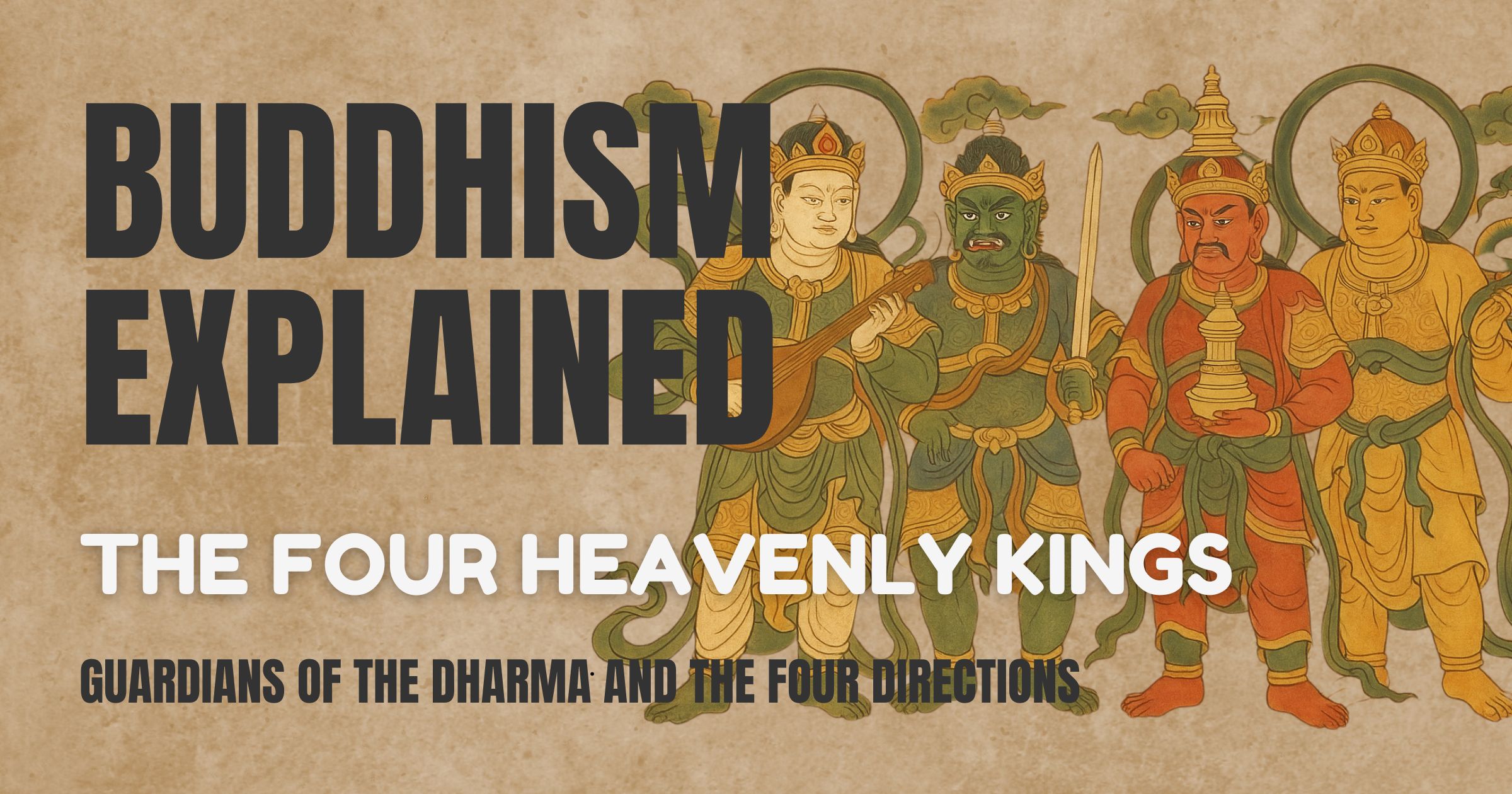
You ever walk into a temple and see four fierce, sword-holding deities glaring down at you from each corner like they’ve been guarding that place since the beginning of time? That’s not just artistic flair. Those are the Caturmahārājakayikas—aka the Four Heavenly Kings—and they’re here to do more than look intimidating.
These aren’t your average celestial bureaucrats. In Buddhist cosmology, they’re powerful beings who protect the Dharma, guard the four directions, and basically act as the cosmic security force for our realm. If the universe had spiritual border patrol, it would be these guys.
But don’t worry—they’re not here to judge your meditation posture. They’re here to keep the world from falling apart. And honestly, in this era of endless scrolls, war, and Wi-Fi addiction, I’m glad someone’s on cosmic duty.
Let’s meet the team.
The Caturmahārājakayika Squad
The Four Heavenly Kings aren’t just a set of cool names—they each govern one of the four cardinal directions and command a crew of mythical beings that help them maintain order and protect the teachings of the Buddha.
Here’s the lineup:
Dhṛtarāṣṭra (East) – The One Who Upholds the Nation
- Sanskrit: Dhṛtarāṣṭra | Chinese: 持国天 (Chíguótiān)
- Direction: East
- Crew: Gandharvas (celestial musicians)
- Symbolism: Stability, protection, leadership
Dhṛtarāṣṭra’s name literally means “Upholder of the Nation,” and if that sounds like a national security role, that’s because it is. He’s responsible for maintaining social and spiritual order, especially in the eastern realm.
He leads the Gandharvas, those celestial musicians who aren’t just jamming in the clouds—they’re maintaining vibrational balance in the world. In some traditions, their music literally sustains cosmic harmony.
Virūḍhaka (South) – The One Who Causes Growth
- Sanskrit: Virūḍhaka | Chinese: 增长天 (Zēngzhǎngtiān)
- Direction: South
- Crew: Kumbhāṇḍas (tree spirits, plant devas)
- Symbolism: Growth, nurturing, expansion
Virūḍhaka is the king of growth—not just crops and trees, but the growth of the Dharma. He’s the kind of figure that makes sure things are expanding in the right direction. Think spiritual gardener mixed with military general.
He leads the Kumbhāṇḍas, mysterious nature spirits often linked to trees and fertility. Together, they help nurture Dharma practitioners and keep the spiritual soil healthy.
Virūpākṣa (West) – The One Who Sees All
- Sanskrit: Virūpākṣa | Chinese: 广目天 (Guǎngmùtiān)
- Direction: West
- Crew: Nāgas (serpent spirits, water beings)
- Symbolism: Vision, watchfulness, protection
Virūpākṣa is the western guardian, and his name translates to something like “Wide-Eyed” or “All-Seeing.” He’s the one watching out for subtle threats—the kind you don’t even know are coming.
He commands the Nāgas, mystical snake-like beings connected to water, transformation, and hidden knowledge. These aren’t your average reptiles—they’re ancient protectors who often guard temples, texts, and sacred places.
Vaiśravaṇa (North) – The One Who Hears All
- Sanskrit: Vaiśravaṇa | Chinese: 多闻天 (Duōwéntiān)
- Direction: North
- Crew: Yakṣas (nature spirits, wealth guardians)
- Symbolism: Wealth, generosity, protection
Vaiśravaṇa is probably the most famous of the four. He’s also known as Jambhala, a god of wealth in many Buddhist traditions. But he’s not a spiritual ATM—he’s a protector of resources, ensuring that wealth (material and spiritual) is used wisely.
He leads the Yakṣas, spirits associated with forests, mountains, and treasure. While they can be mischievous in some tales, under Vaiśravaṇa’s leadership, they become protectors of abundance and Dharma.
Where Do They Live?
The Four Kings reside in the Caturmahārājakayika Heaven, which is:
- The lowest of the six heavens in the desire realm (Kāmadhātu)
- Located at the base of Mount Sumeru, the mythical mountain at the center of the Buddhist universe
- Positioned between the earthly world and the higher celestial realms
Think of it as the cosmic lobby—they’re close enough to respond to earthly problems, but still operating at a divine frequency.
What Do They Actually Do?
Besides looking cool in temple art, the Four Kings have a full job description:
- Guard the Four Directions – Each one maintains spiritual balance in their corner of the world.
- Protect the Dharma – They show up in sutras to shield the Buddha and his followers from negative forces.
- Command Supernatural Beings – Their squads (Nāgas, Gandharvas, etc.) help them manage natural forces like weather, fertility, health, and even psychic attacks.
- Maintain Cosmic Order – Basically, they make sure the world doesn’t descend into chaos—spiritually, environmentally, karmically.
And yes, they sometimes get worshipped in rituals, especially when people need protection, courage, or clarity. You’ll often see statues of them at temple gates, warding off evil and guiding sincere practitioners.
In Art and Temples
If you’ve ever walked through a Buddhist temple and felt like someone was silently judging your karma—it was probably a statue of one of these guys.
They’re often depicted:
- Holding weapons (swords, tridents, pikes)
- Wearing armor and fierce expressions
- Standing tall and square at temple entrances
But the message isn’t intimidation—it’s protection. They’re there to guard sacred space so your inner transformation has room to breathe.
What the Four Kings Represent Spiritually
Each of the Four Kings isn’t just a directional guardian. They embody forces within you, and their mythological descriptions are actually metaphors for qualities we need on the path.
Dhṛtarāṣṭra – Inner Discipline & Moral Integrity
- Protects the East, home of new beginnings
- Represents order, structure, and social responsibility
- His Gandharvas symbolize the harmony we can cultivate through right speech and ethical living
In you: Dhṛtarāṣṭra shows up when you hold your values firm, even when it’s easier to drift. He reminds you that the world—and your mind—needs structure with heart.
Virūḍhaka – Growth, Courage & Spiritual Expansion
- Protects the South, a direction of heat and action
- Embodies dynamic growth and inner strength
- His Kumbhāṇḍas are nature spirits—raw, rooted, untamed
In you: Virūḍhaka is the force that nudges you to get unstuck, to expand beyond your comfort zone, and to keep watering the seeds of your practice even when nothing seems to be sprouting.
Virūpākṣa – Awareness, Insight & Guarded Perception
- Watches the West, the direction of the setting sun and endings
- Symbolizes discriminating awareness and watchfulness
- Leads the Nāgas—beings of hidden wisdom, water, and transformation
In you: Virūpākṣa is the protector of your inner clarity. He’s the “eyes in the back of your head” that catch delusion sneaking in. He sees through illusions—and invites you to do the same.
Vaiśravaṇa – Protection, Generosity & Right Use of Power
- Guards the North, associated with mystery, hidden treasure, and strength
- His Yakṣas guard both material wealth and inner richness
- He’s a dharmic Robin Hood—protecting abundance and ensuring it’s used for good
In you: Vaiśravaṇa is the reminder that true power lies in protection, not domination. He supports the right use of energy, resources, and time. Think of him as the spiritual bouncer who knows your worth and keeps out what drains you.
The Four Kings in Buddhist Practice
In real-world Buddhist practice, the Four Kings aren’t just symbolic. They’re invoked in rituals—especially when:
- Seeking protection from obstacles (physical or spiritual)
- Beginning a big undertaking (like a retreat or temple construction)
- Performing temple consecrations or Dharma ceremonies
You’ll also find them stationed at the four gates of many temples—literally guarding the threshold between the mundane and the sacred.
And that’s no accident. Every time you walk through those gates, you’re metaphorically saying:
“I’m stepping into sacred space, and I leave chaos at the door.”
Why They Still Matter Today
Let’s be real—most of us aren’t battling nāgas or demonic armies. Our enemies look more like:
- Mindless distraction
- Emotional overwhelm
- Burnout
- Hopelessness
- Indecision
But the Four Kings? They still apply.
Because we’re still trying to protect our peace, guard our practice, and keep our spiritual lives from being overrun by the noise of the world.
Each King reminds us of a principle we need:
- Dhṛtarāṣṭra: Keep your integrity.
- Virūḍhaka: Keep growing.
- Virūpākṣa: Keep seeing clearly.
- Vaiśravaṇa: Protect what matters.
They’re not just out there in the heavens. They’re in here, waiting for us to remember.
Final Thoughts: Four Guardians, One Message
The Four Heavenly Kings are big, bold, and maybe a little intimidating. But at their core, they’re saying something simple:
“This path is sacred. Let’s protect it.”
And that’s something worth remembering. In a world that often treats spirituality like a side hobby or a weekend project, the Kings remind us that awakening is serious work—but it’s also worth guarding.
So the next time you feel scattered, vulnerable, or spiritually adrift, call on them—not with rituals or incense (unless that’s your thing), but with intention.
Because the world needs more protectors of what’s real.
And you? You might just be one of them.





 简体中文
简体中文  English