
Let’s get one thing out of the way: everyone takes refuge in something.
Whether it’s Netflix, bubble tea, your phone, or that never-ending to-do list, we all have our go-to “safe spaces.” The problem is, not all of them actually help when life kicks you in the face. That’s where Buddhism offers something a little sturdier—what it calls the Three Jewels, or Triple Gem.
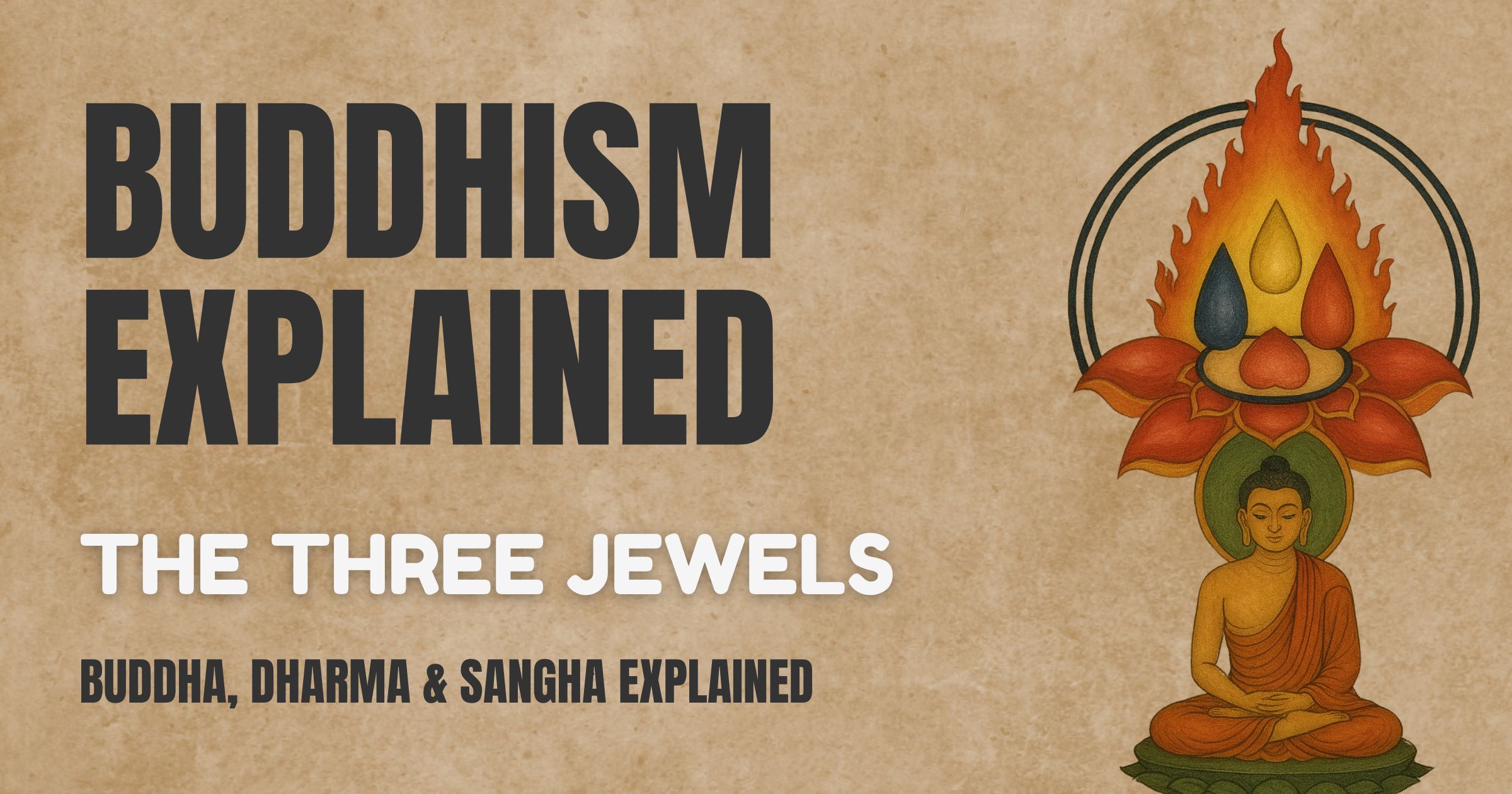
These aren’t magical stones or objects you keep on your altar (although they sound like they should be). They’re Buddha, Dharma, and Sangha—three cornerstones of Buddhist practice that form the emotional, spiritual, and practical support system for anyone walking the path of awakening.
And here’s the deal: you don’t have to be a monk or have a shaved head to connect with them. The Three Jewels aren’t religious dogma. They’re lived experiences. Anchors. Compass points. A kind of spiritual “reboot” you can hit anytime, anywhere.
Let’s start from the top.
Jewel One: The Buddha – The Possibility of Awakening
Most people think “Buddha” means some enlightened god who’s out there somewhere, floating on a lotus and looking vaguely bored. And sure, Siddhartha Gautama—the historical Buddha—is a key figure here. But in Buddhist thought, “Buddha” is more than a guy. It’s a state of being.
Taking refuge in the Buddha means you believe that:
- Awakening is real
- It’s been done before
- And it’s possible for you
That’s a big shift from the usual “I’m too messed up to meditate” self-talk. The Buddha didn’t come to flex his spiritual muscles—he came to show a path that works. No magic. No hierarchy. Just a way out of suffering through observation, effort, and understanding.
You might not be able to sit under a Bodhi tree for 49 days straight, but every time you pause to breathe instead of react, every time you choose kindness over pettiness, you’re stepping a little closer to the Buddha’s path.
The Buddha as Mirror
Another way to think of the Buddha is as a mirror. He doesn’t hand you answers. He shows you what’s already there—the capacity for peace, insight, and compassion that’s buried under layers of habit and noise.
You’re not worshipping the Buddha when you take refuge. You’re saying: “I trust the example he set—and I believe I have the same seeds of awakening inside me.”
That’s not delusion. That’s courage.
Jewel Two: The Dharma – The Map and the Medicine
Okay, so you’ve got a goal: awakening. But how do you get there?
That’s where the Dharma comes in.
The Dharma is often defined as “the teachings,” but honestly, that’s underselling it. The Dharma is:
- A map that guides you toward clarity
- A medicine that treats the root causes of suffering
- A mirror that reflects reality as it is—not how we wish it was
This includes big ideas like the Four Noble Truths, the Eightfold Path, and concepts like impermanence (anicca), non-self (anattā), and dependent origination (paṭiccasamuppāda). But it’s not just philosophy. It’s practical life advice dressed up in ancient language.
Applying Dharma to Everyday Life
Let’s say you’re stuck in traffic. You’re late. You’re mad. Someone just cut you off and flipped you the bird.
Dharma doesn’t say, “Ignore your feelings.” It says:
- Notice your reaction
- Ask yourself where it’s coming from
- Remember that this feeling—like all things—is impermanent
You’re not spiritually failing because you got irritated. You’re spiritually practicing when you recognize what’s happening and choose not to feed the fire. That’s Dharma in action. That’s what it means to walk the path, even if your path is literally a gridlocked freeway.
The Dharma Is Universal
One of the coolest things about the Dharma? It’s not exclusive. You don’t have to be Buddhist to benefit from it. It doesn’t ask you to believe—it asks you to observe.
Suffering is real. We crave things. We cling to things. We fear change. And those habits cause pain. Buddhism doesn’t claim to “fix” you—it just shows you how the system works and gives you tools to rewire it.
And when you start to see things more clearly, even a little bit? That’s the Dharma doing its job.
Jewel Three: The Sangha – Your Spiritual Crew
Sangha (संघ) is often translated as “community,” but in early Buddhism, it specifically referred to the monastic order—the Bhikṣus and Bhikṣuṇīs who committed their lives to the path. Today, especially in Mahāyāna and lay practice, Sangha has expanded to include any community of people committed to practicing the Dharma together.
Yes, that includes monks and nuns. But also:
- The meditation group you meet with on Sundays
- The friend who sends you sutta quotes when you’re struggling
- The stranger on a forum who replies to your rant with “breathe”
The Sangha isn’t just about robes and chants. It’s about support.
Why We Need a Sangha (Even If We Think We Don’t)
I used to think I could do it all solo—read a few books, meditate on my own, keep my spiritual practice personal and private. But over time, life showed me how easy it is to lose your way when you’re walking alone.
You forget your intention. You start skipping practices. You spiral into doubt. And suddenly, you’re not even on the path anymore—you’re just spiritually daydreaming.
That’s where the Sangha comes in. It holds space when your motivation is shaky. It reflects your blind spots. And sometimes, it’s just someone to sit beside in silence so you don’t feel like you’re going crazy.
You don’t need a big, perfect community. Just one person who “gets it” can make all the difference.
Taking Refuge: What It Actually Means
So what does it mean when someone says they “take refuge” in the Buddha, Dharma, and Sangha?
In Buddhist practice, this isn’t just symbolic. It’s a conscious turning toward wisdom. A way of saying:
“I know the world is uncertain. I know my mind is a mess sometimes. But I’m choosing this path—not because it’s easy, but because it’s true.”
Traditionally, people recite:
- “I take refuge in the Buddha” – I trust the example of awakening
- “I take refuge in the Dharma” – I trust the teachings to guide me
- “I take refuge in the Sangha” – I trust the community to support me
It’s not about being perfect. It’s about being aligned. And when you start from that place, even small efforts feel sacred.
Living the Three Jewels (Without a Temple)
You don’t need to live in a monastery or wear a mala to live the Three Jewels. You just need to remember them when life gets loud.
When you’re anxious about the future—take refuge in the Buddha.
When your thoughts spiral—take refuge in the Dharma.
When you feel alone—take refuge in the Sangha.
You can turn to a book, a breath, a friend, or even a mantra. The form doesn’t matter as much as the intention behind it.
Each jewel reflects a different aspect of stability:
- Buddha = the goal
- Dharma = the method
- Sangha = the support system
Together, they form a kind of spiritual tripod. Take one away, and things get shaky. Keep all three in sight? You’ve got balance.
Final Thoughts: You’re Not Alone in This
The most beautiful thing about the Three Jewels is that they’re always accessible.
Even on the worst days, you can whisper “Buddha, Dharma, Sangha” and feel a tiny bit of clarity return. You can remember that people before you have walked this path—and people beside you are walking it too.
You’re not the first person to feel lost. And you won’t be the last. But you’re also not doing it alone.
So take refuge—not in distractions, not in panic, not in the endless scroll—but in something stable. Something sacred. Something that’s been lighting the way for 2,500 years.
Because sometimes, the most revolutionary thing you can do… is simply stay on the path.

 简体中文
简体中文  English