
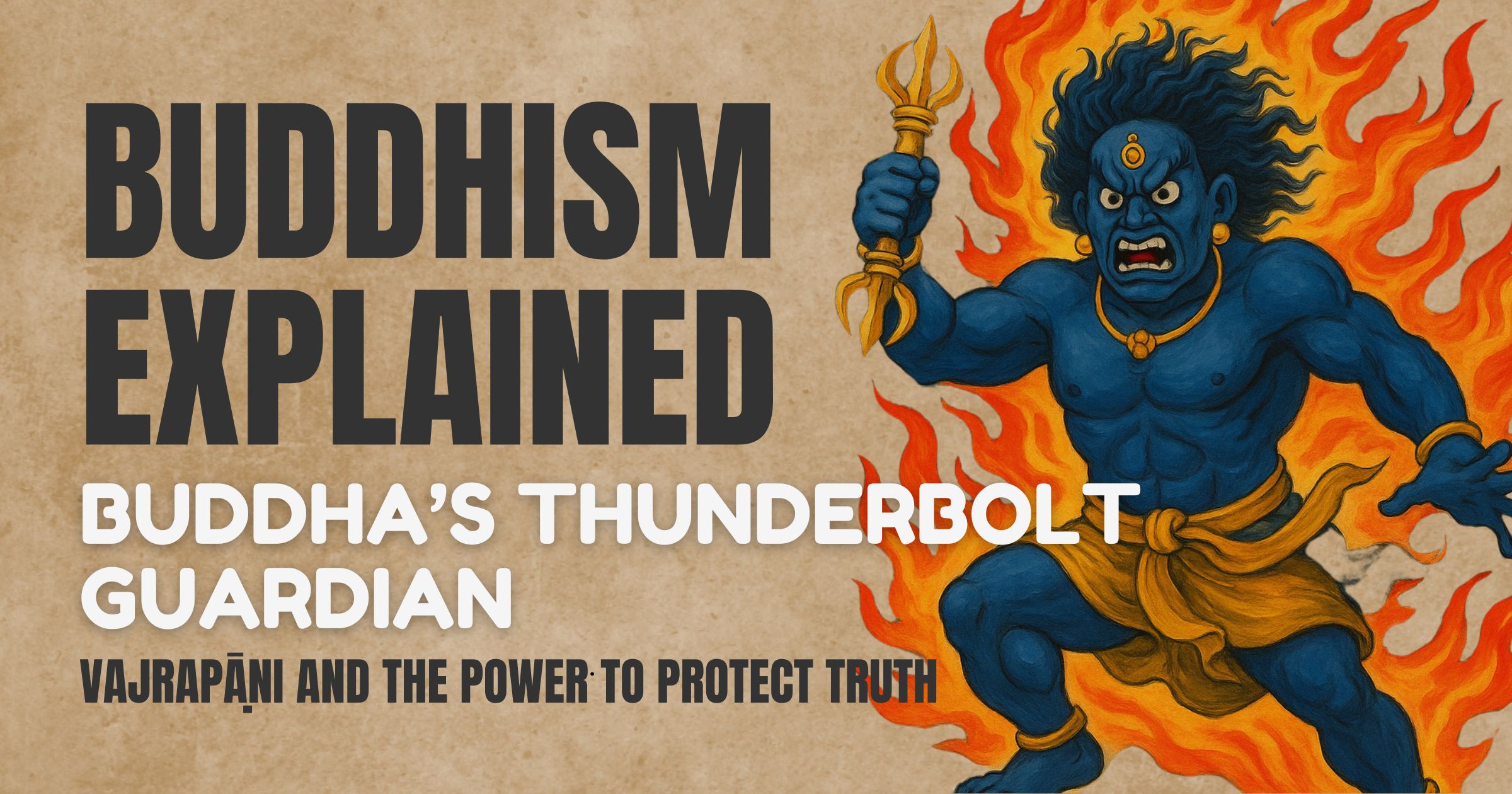
Okay, imagine the Buddha sitting calmly, eyes half-closed, emanating peaceful vibes—and behind him stands this muscle-bound, wrath-faced deity holding a thunderbolt like he’s about to go full WWE on any demon that gets too close.
That’s Vajrapāṇi (वज्रपाणि). He’s not here for tea and quiet contemplation. He’s here to protect the Dharma with thunder, might, and zero tolerance for ignorance.
So who exactly is Vajrapāṇi? Why does a tradition known for non-violence and serenity have such a wrathful protector? And what does he represent beyond the biceps and lightning?
Let’s find out.
Who Is Vajrapāṇi?
The name Vajrapāṇi means “Bearer of the Vajra.” A vajra is a thunderbolt or diamond weapon—indestructible, unstoppable, and symbolically associated with unshakable truth and spiritual power.
Vajrapāṇi is often depicted:
- With a muscular body, sometimes blue or dark in color
- Surrounded by flames or storm clouds
- Holding a vajra in his raised hand, ready to strike
- Wearing a skull crown or adorned with snakes, depending on regional depictions
He’s not your typical soft-spoken spiritual figure. He’s a guardian, a bodhisattva of power, and often seen alongside Avalokiteśvara (compassion) and Mañjuśrī (wisdom) as part of a trinity representing the core energies of enlightenment.
Vajrapāṇi in Action: The Buddha’s Bodyguard
In Buddhist stories, Vajrapāṇi is more than symbolic muscle. He’s literally described as a protector of the historical Buddha.
In one early legend, when a group of rogue monks plotted against the Buddha, it was Vajrapāṇi who appeared—flaming and terrifying—to scatter them. Think of him as the cosmic bouncer for the Buddha’s teachings. If Māra and his forces try to sneak in? Vajrapāṇi shows them the door.
But he doesn’t protect with blind aggression. His power is rooted in spiritual strength and clarity—a symbol of what it takes to overcome inner and outer obstacles.
What Vajrapāṇi Represents
Underneath the thunder and flames, Vajrapāṇi represents something incredibly important: the energy needed to break through delusion.
He’s not angry in the petty human sense—he’s wrathful compassion. He embodies:
- Fearless determination on the path
- The power to cut through ignorance
- Protection of the Dharma against distortion or abuse
- The transformative force that turns fear into freedom
In Tibetan Buddhism, Vajrapāṇi is associated with fierce tantric energy—called upon in rituals that require deep purification or energetic transformation. He’s not for beginners. But he’s also not just for warriors—he’s for anyone ready to face the hard stuff with courage.
Vajrapāṇi in Art and Culture
You’ll find Vajrapāṇi in temples across India, Nepal, Tibet, China, and Japan, often in dramatically different forms:
- In Gandhāran art, he looks like Heracles, complete with lion skin and club.
- In China, he appears as one of the two temple gate guardians—the Nio, alongside another fierce protector.
- In Tibet, his form is often wrathful, with bulging eyes, fangs, and fire hair, representing tantric force.
Every version sends the same message: truth needs guardians. Not to exclude people—but to preserve clarity. To protect what matters.
What Vajrapāṇi Teaches Us Today
You don’t need a vajra or six-pack abs to connect with Vajrapāṇi’s energy. His real lesson is this:
- Stand up for your path.
- Cut through confusion.
- Channel your inner thunderbolt.
In a world where we’re constantly distracted, discouraged, or spiritually dulled, Vajrapāṇi reminds us that awakening isn’t always gentle. Sometimes, it’s fierce. Sometimes, it takes fire to break free.
Final Thoughts: Thunder in Stillness
Vajrapāṇi shows us that peace isn’t passive. It’s protected. It’s earned. It’s held by those willing to stand firm against ignorance—not with violence, but with unshakable spiritual force.
So whether you’re meditating, studying, or just trying not to scream into your coffee cup today—channel a little Vajrapāṇi. Be fierce. Be steady. Be a thunderbolt in the storm.


 简体中文
简体中文  English