
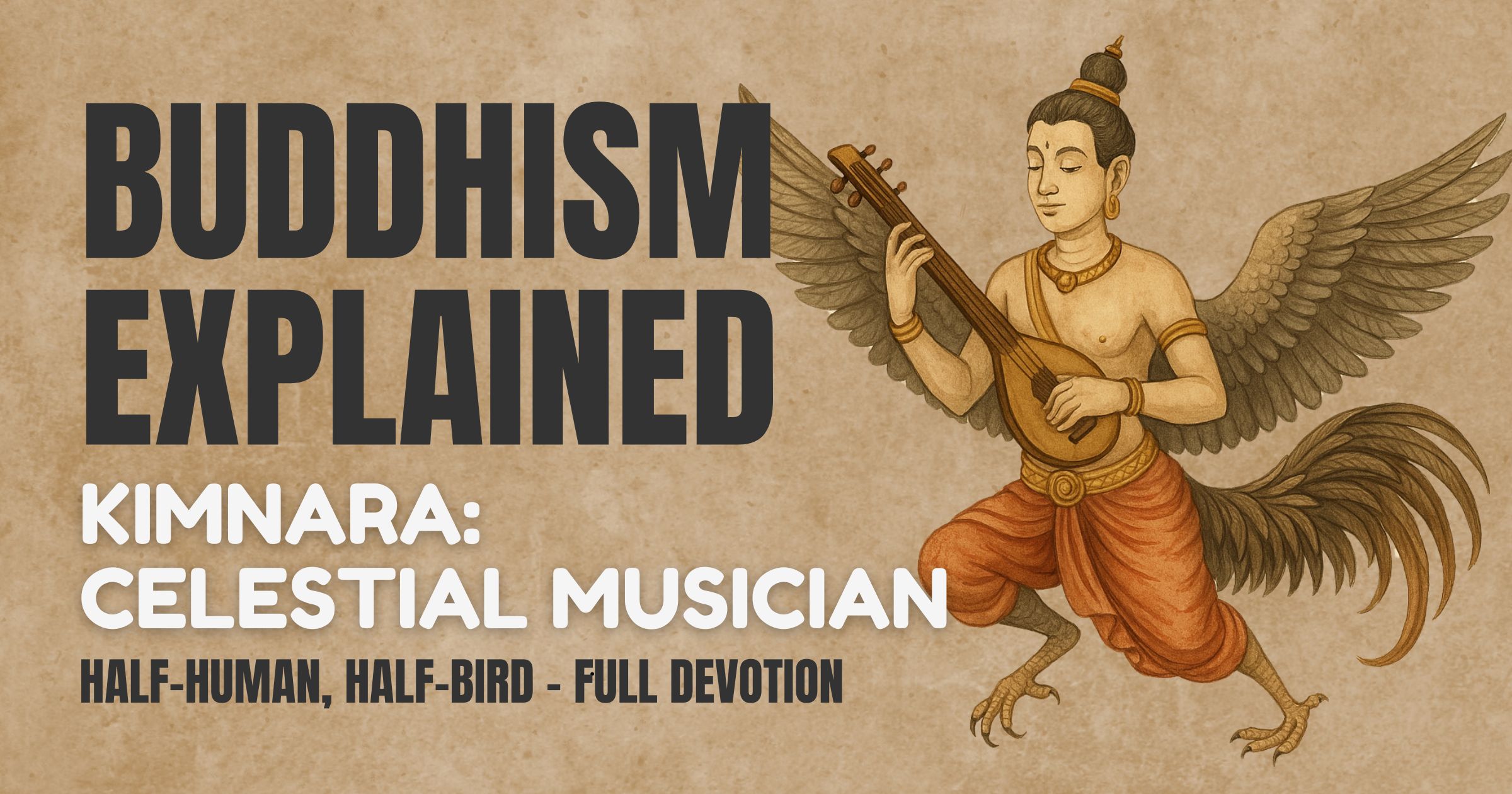
Some beings make noise. Others make music. The Kiṁnara sings.
This half-human, half-bird celestial figure—often overlooked in favor of flashier gods or fearsome demons—holds a quiet power. A spiritual rhythm. A harmony so profound it’s said to move the hearts of deities and disciples alike.
Found across Hindu and Buddhist mythology, Kiṁnaras appear in art, poetry, sculpture, and scripture. They’re described as musicians of heaven, guardians of Dharma, lovers without ego, and reminders that beauty, when offered mindfully, becomes a sacred act.
Let’s begin our journey into their origin, metaphysical purpose, and the deeper question behind their name: “What (really) is human?”
Origins and Name: What Human, Indeed?
The name Kiṁnara (किंनर) comes from a question: kim nara?—“Is it human?”
It’s not just a linguistic pun. It’s a spiritual riddle.
In Hindu and Buddhist cosmology, Kiṁnaras defy neat classification. They walk (or fly) between human and divine, music and silence, passion and purity. They appear mostly in pairs—Kiṁnara (male) and Kiṁnarī (female)—and are almost always engaged in some act of devotion: playing music, gazing lovingly, holding the space with presence.
In Hindu tradition, they serve in the celestial court of Indra, lord of the heavens. In Buddhism, they evolve further—becoming part of the Eight Legions (Aṣṭasenā), the mythical guardians of the Dharma.
Yet their power is never about dominance. It’s about tuning in. Listening. Loving. Singing the soul’s truth into the open.
Kiṁnaras in the Buddhist World: More Than Myth
In Mahāyāna sutras, especially the Lotus Sutra, Kiṁnaras show up as part of a diverse crowd—devas, yakṣas, nāgas, asuras—all gathering to hear the Buddha teach. Each type of being represents a spiritual archetype. The Kiṁnara’s role? Musical protector. Emotional alchemist. Harmonizer of devotion and beauty.
They symbolize:
- Sacred partnership – male and female Kiṁnaras often appear together, eyes locked in mutual understanding
- Emotional clarity – love without attachment, music without ego
- Aesthetic power as path – showing that art and beauty can be Dharma tools, not just distractions
This quiet strength is why you often see Kiṁnaras carved onto temple walls or under roof beams—not towering like gods, but supporting, holding space like unseen musicians in a cosmic orchestra.
Regional Depictions
As Buddhism spread across Asia, the image and symbolism of the Kiṁnara shifted to match local cultures, creating a patchwork of sacred interpretations:
🇮🇳 India – From Centaur to Songbird
In early Hindu texts, Kiṁnaras are sometimes depicted as half-human, half-horse—a bit more like centaurs. But as Buddhist thought took shape, the form evolved into half-human, half-bird, with the upper body often human and the lower body feathered or winged.
The transformation isn’t just visual—it’s symbolic of refinement. Horses are wild and strong; birds are light, free, and tuned to the air—like consciousness.
🇲🇲 Myanmar – Sacred Lives of the Buddha
In Burmese Buddhism, the Kiṁnara is known as keinnaya (male) and keinnayi (female). And here’s a fun fact: the Buddha himself is believed to have lived four past lives as a Kiṁnara.
This isn’t a minor role—it’s a karmic milestone. The image of the Kiṁnara becomes one of moral purity, spiritual loyalty, and quiet wisdom.
They’re also one of the 108 auspicious signs on the Buddha’s footprint, reinforcing their importance in the spiritual hierarchy—not loud, but essential.
🇰🇭 Cambodia – Guardians of Grace
In Cambodia, they’re called kenar, and they show up especially in post-Angkorian art, often as support figurines—carved beneath pillars, silently holding up sacred structures.
Here, the kinnari (female Kiṁnara) is more prominent, symbolizing dance, beauty, and elegance. Her form is revered, not objectified—a graceful presence reminding devotees that art, when sincere, is a form of offering.
🇮🇩 Indonesia – Protectors of the Tree of Life
Indonesian temples like Borobudur and Prambanan frequently depict paired Kiṁnara and Kiṁnarī, often flanking the Kalpataru (tree of life) or guarding treasure jars.
Their presence here isn’t just ornamental—it’s mythic. They serve as guardians of abundance, suggesting that spiritual prosperity grows when devotion and harmony are present.
🇹🇭 Thailand – The Flying Maiden
In Thai mythology, the kinnari has become one of the most iconic figures of cultural beauty. She’s depicted as a young, elegant woman with a human upper body and bird-like lower limbs, including delicate wings.
What’s powerful here isn’t just the visual—it’s the meaning. The Thai kinnari is seen as a bridge between the human and mystical realms, able to fly between worlds. She’s a symbol of femininity, gentleness, loyalty, and emotional intelligence.
The most famous kinnari depictions are found at Wat Phra Kaew in Bangkok—golden, poised, and ethereal.
But there’s also a story beneath the gold: in Thai folktales, kinnaris sometimes suffer injustice, are separated from their lovers, or face trials. Yet they remain devoted—not through weakness, but through depth. Their devotion is not naive. It’s transformative.
Tibet – Miamchi and the Cymbal of Enlightened Activity
In Tibetan Buddhism, Kiṁnara appears as Miamchi or Shang-shang—a celestial musician often shown with cymbals or winged features. The Nyingma tradition (the oldest Tibetan school) interprets the Shang-shang as a symbol of enlightened activity.
Here, sound is not just an aesthetic—it’s a ritual tool. The “shang” (cymbal) is both instrument and symbol, representing the vibrational power of awakened action.
It’s also a homonymic play—blending sound, spirit, and sacred function. In some iconography, Shang-shang is even depicted as king of the Garuḍas—a mystical elevation that shows just how spiritually significant the Kiṁnara form can become.
China & Chinese Buddhism – The Ambiguous Non-Human
In Chinese Buddhism, the Kiṁnara is translated into various forms: 紧那罗, 紧捺洛, 真陀罗, and others. The translations often emphasize mystery—terms like “疑神” (doubtful god), “人非人” (not-quite-human), or “音乐天” (heavenly music spirit) appear in ancient texts.
In this view, Kiṁnaras represent a kind of liminal being—part spirit, part artist, straddling the line between form and formlessness. They’re often mentioned in sutras as musical devas, playing instruments to welcome Buddhas or adorn teachings with their sound.
What’s especially interesting in Chinese Buddhist literature is the ambiguity of form—sometimes described as having horse heads (male) or graceful female human faces, echoing the older Indian and Central Asian representations.
Beyond Myth: What the Kiṁnara Symbolizes in Us
Now that we’ve toured half of Asia with our feathered friends, let’s bring it back home.
What does the Kiṁnara mean—not just in art, but in your life?
They’re not just celestial side characters. They are archetypes of our own potential.
- Music – The ability to create harmony amidst chaos.
- Devotion – The power of love that lifts instead of clings.
- Beauty – Not vanity, but the ability to present something sacred, well-crafted, and healing.
- Dual nature – The reminder that we’re not just physical creatures. There’s something spiritual, winged, luminous within us too.
And maybe most importantly, they show that gentleness is not weakness. The Kiṁnara doesn’t shout. It sings. It protects not with armor, but with loyalty, rhythm, and presence.
Kiṁnara as Dharma Protector
Let’s not forget—despite their soft edges, Kiṁnaras are part of the Eight Legions who vowed to protect the Dharma.
In that sense, they serve a serious spiritual role. They might not breathe fire like dragons or shake the earth like Vajrapāṇi—but they preserve the inner atmosphere of practice. They hold the container. They make the sacred feel sacred.
And honestly, in a noisy world that’s more full of hot takes than harmony… that’s a power we need.
Final Thoughts: Let Your Practice Sing
So here’s the takeaway.
You don’t need to be half-bird, wear gold feathers, or strum a celestial harp to walk the Kiṁnara path. You just need to:
- Bring beauty into your practice
- Be loyal to what awakens you
- Use your voice mindfully
- Treat love as something sacred, not possessive
Because the Kiṁnara doesn’t roar, conquer, or dominate. It simply shows up in full harmony, offering music to the Dharma, love to its partner, and wings to the spirit.
That’s not mythology. That’s a way to live.
 English
  简体中文
简体中文