
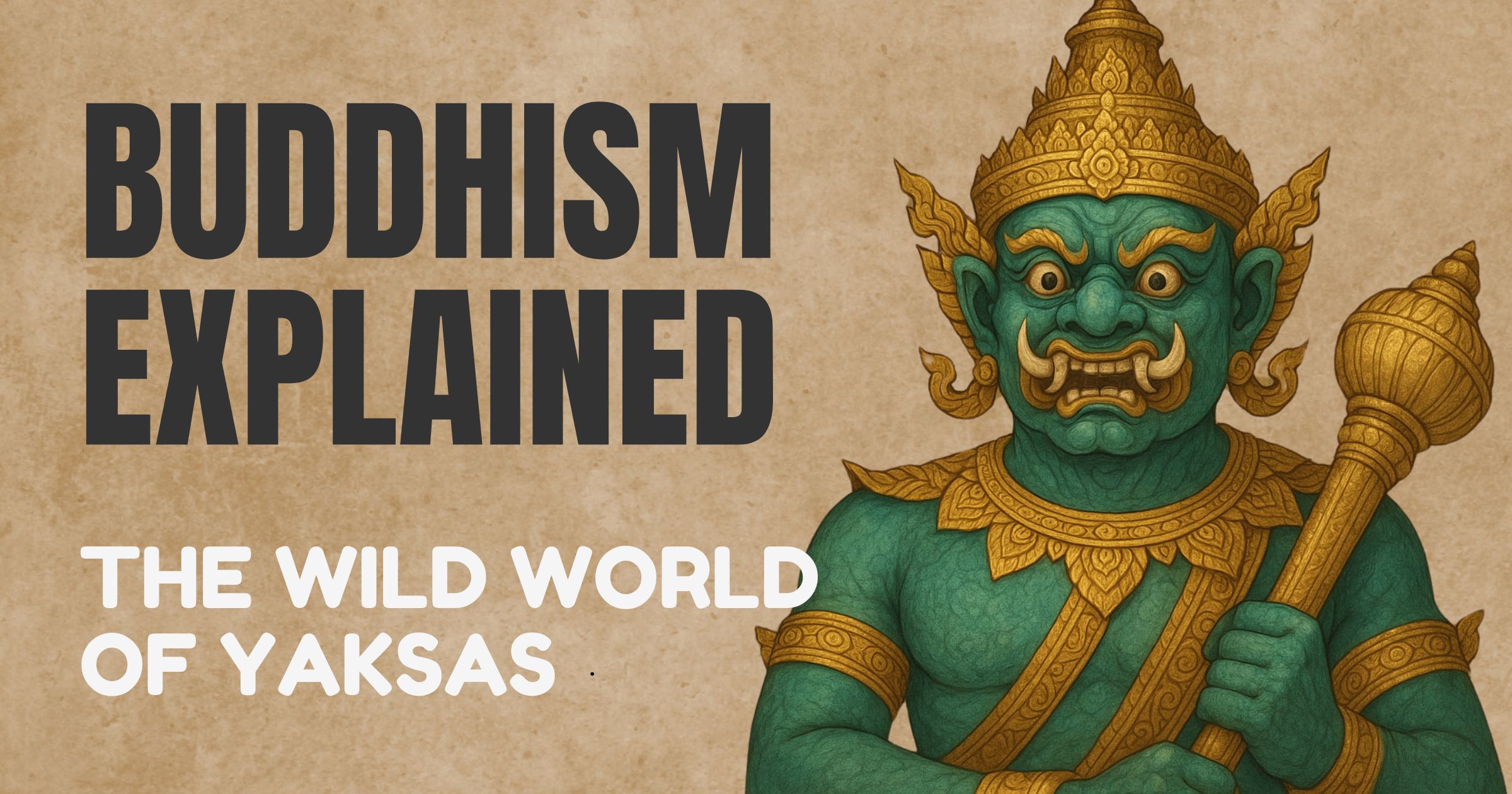
So I’ve been diving into Buddhist mythology lately (yes, again), and one group of beings keeps popping up in the weirdest places—Yakṣas. These aren’t your run-of-the-mill deities or cartoonish demons. Nope. Yakṣas are a whole different category: part forest spirit, part celestial bodyguard, part “what was that sound in the woods?”
And what really got me hooked was this: instead of ignoring or getting rid of these wild spirits, Buddhism gave them a job. Like, an actual spiritual promotion.
We’re talking about chaotic nature beings who now stand at the gates of temples guarding the teachings of the Buddha. If that doesn’t spark your curiosity, I don’t know what will.
Wait—What Even Is a Yakṣa?
Good question. Yakṣas (pronounced roughly “yuck-shahs”) come from ancient Indian folklore. They were around way before Buddhism rolled onto the scene, showing up in Vedic literature and local oral traditions. Depending on the region and the storyteller, they could be anything from:
- Kind, tree-dwelling spirits who bless the land with fertility,
- Creepy cave guardians who hoard treasure and glare at intruders,
- Or giant beings with fangs who you definitely don’t want to meet on a night hike.
They’re what scholars call “ambivalent spirits,” which is basically a polite way of saying “they might save you or eat you, depending on their mood.”
The Buddhist Remix
When Buddhism started gaining momentum in India around the 5th to 6th century BCE, it didn’t hit delete on existing beliefs. Instead, it did something smart: it absorbed a lot of these older stories and gave them new context.
So instead of saying “Yakṣas are dangerous and unspiritual,” Buddhist thinkers were like, “Maybe they just need some Dharma in their lives.”
And thus began the transformation of the Yakṣa.
Some were reimagined as temple guardians, protectors of sacred texts, or servants of higher deities. Others were literally converted—there are early stories where the Buddha himself encounters Yakṣas and, through wisdom and compassion, changes their minds (and their roles).
From Forest Spirit to Celestial General: The Case of Vaiśravaṇa
Now let’s talk about the most famous Yakṣa in the Buddhist world: Vaiśravaṇa.
Originally, he was known in Hindu tradition as Kubera, the god of wealth. But in Buddhism, he undergoes a full rebranding. He becomes the King of the North, one of the Four Heavenly Kings (Caturmahārāja), who are like the universe’s divine border patrol.
Vaiśravaṇa isn’t just any Yakṣa—he becomes their leader. He’s often depicted standing tall, wearing heavy armor, holding a banner of victory, and sometimes a stupa in one hand. He’s a symbol of protection, stability, and the righteous use of power.
What I love about this is how it mirrors what Buddhism often does: taking something potentially wild or threatening and giving it a sacred function. Power doesn’t need to be erased. It just needs a direction.
The Buddha’s Encounters with Yakṣas
There are also smaller, lesser-known stories in early Buddhist texts—especially in the Pāli Canon—where Yakṣas show up during the Buddha’s lifetime. And surprise: not all of them are immediately friendly.
Some arrive with suspicion or even hostility. A few threaten monks or challenge the Buddha’s authority. But what happens next is where it gets interesting.
The Buddha doesn’t retaliate. He talks. He listens. He teaches.
In more than one case, the Yakṣa walks away changed. Sometimes they vow to protect a sacred place or commit to helping spiritual seekers. One even asks how to progress on the path themselves.
It’s classic Buddhist storytelling: confrontation followed by understanding, transformation through wisdom.
The Symbolism Beneath the Story
Now, you might be wondering—why does this matter? I mean, it’s all cool mythology, but does it actually apply to anything?
Here’s what I take from it:
Yakṣas represent the untamed parts of existence—the things we don’t fully control. Nature. Emotions. Old beliefs. Shadowy thoughts. Instincts. And instead of telling us to reject those things, Buddhism shows us how to work with them.
You don’t have to cut off the wild part of yourself to be spiritual. You just have to learn how to redirect it.
The Yakṣa becomes a protector not by changing what it is at the core, but by changing its relationship with the world. And that, to me, is kind of powerful.
Why We Still See Them at Temples Today
If you’ve ever been to a Buddhist temple—especially in places like Thailand, Japan, or Nepal—you’ve probably seen statues that look like warrior gods or fierce giants standing guard at the entrance.
A lot of these are Yakṣas (or at least inspired by them).
Their role is to protect the temple. To stand at the threshold between the ordinary world and the sacred space inside. They’re not just scary gatekeepers. They’re symbols.
They remind you that entering a spiritual space isn’t just about peace and incense and chanting—it’s also about facing your inner dragons. It’s about being willing to confront what’s wild in yourself, and walk in anyway.
What the Yakṣas Teach Us Today
At the end of the day, I think Yakṣas have stuck around for a reason.
They show us that transformation doesn’t always mean becoming soft and serene. Sometimes, it means becoming fierce for the right reasons. It means turning old habits into strengths, turning fear into protection, turning chaos into clarity.
It’s not about erasing who we are. It’s about evolving who we are.
And if a fanged forest spirit can make that leap… what’s stopping the rest of us?






 简体中文
简体中文  English