
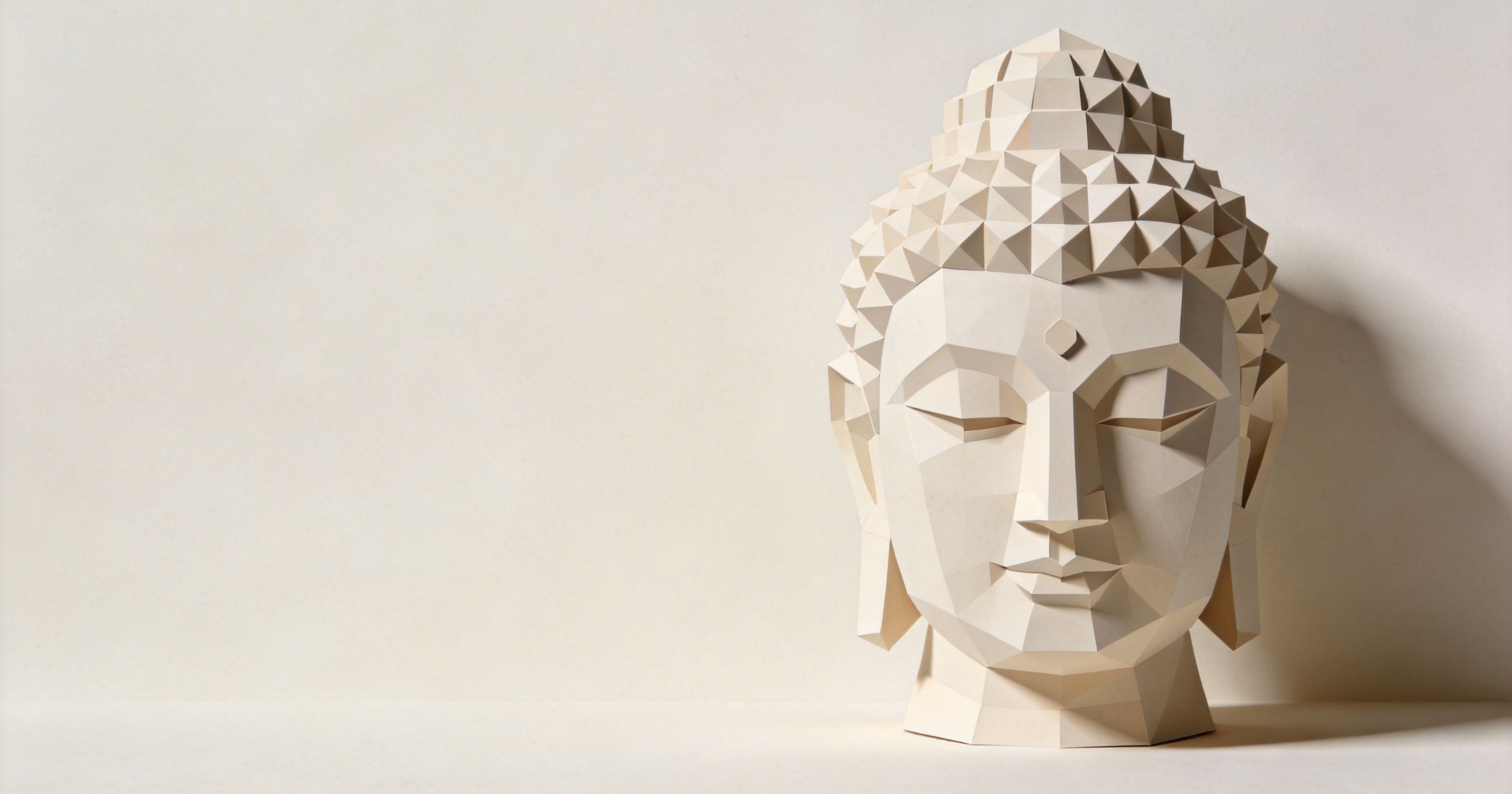
If you walk into different Buddhist spaces around the world, you might feel like you’ve entered entirely different systems.
In one place, there are monks chanting, incense burning, statues being bowed to, and rituals performed with quiet precision. In another, people sit in silence, eyes closed, observing their breath, with no mention of worship at all.
Some people describe Buddhism as a religion—complete with beliefs, traditions, and sacred texts. Others insist it’s not a religion at all, but a philosophy or a practical method for understanding the mind. Both seem equally confident.
But there is another, quieter experience that doesn’t get talked about as often. There are people who have been practicing for years—chanting, participating, believing—and yet feel that the “wisdom” everyone talks about hasn’t quite arrived.
The Question
Is Buddhism fundamentally a religion that asks for belief, or is it a teaching that invites investigation?
And if it is a teaching, why does understanding sometimes feel so distant—even after years of practice?
System Explanation
At its core, Buddhism begins with a simple observation: life involves suffering. Not just dramatic suffering, but a subtle dissatisfaction—the sense that things are never quite enough, never fully stable.
From there, it offers something unusual. Instead of asking for belief in a higher power, it points inward. It suggests that suffering has causes, that these causes can be understood, and that through understanding, suffering can be reduced.
The structure is almost diagnostic. It resembles a system of inquiry more than a system of worship. The early teachings attributed to the Buddha emphasize investigation over blind belief:
“Just as a goldsmith tests gold by rubbing, cutting, and burning, so should you examine my words and accept them, not merely out of reverence.”
But like all systems that interact with human life, Buddhism did not remain in its original form. As it spread across cultures, it encountered something deeper than philosophy—human psychology.
People don’t just seek truth. They seek comfort, rhythm, identity, and belonging. And so, the teaching began to take on structure. Rituals emerged, symbols formed, and communities organized. Over time, what began as a method of inquiry also became a religion.
This transformation is not a distortion. It is a pattern. Ideas that begin as insights often become institutions.
The Gap Between Practice and Insight
Within this system, there is a quieter tension—one that is easy to overlook.
It is possible to practice Buddhism for years and still feel like you haven’t touched its deeper wisdom. You can chant daily, attend rituals, and believe sincerely, and yet feel like something hasn’t quite “clicked.”
This is not necessarily a failure of the teaching. It may be a misunderstanding of how understanding works.
Practice and insight are not the same process. Practice creates conditions—focus, discipline, repetition—but insight requires something else: observation, reflection, and a certain kind of honesty.
There is a subtle shift here, from doing Buddhism to seeing what Buddhism is pointing to. As another teaching suggests:
“Though one may conquer a thousand men in battle, the one who conquers himself is the greatest victor.”
The emphasis quietly moves inward.
Chanting as a Tool, Not the Outcome
Chanting, for example, can be understood in different ways.
On the surface, it looks like a religious act, and sometimes it is practiced that way—an expression of devotion or faith. But psychologically, chanting also does something more neutral. It creates rhythm, stabilizes attention, and gives the mind something to hold onto.
What happens within that space, however, is not determined by the chant itself, but by how the mind engages with it.
Two people can chant the same words for the same amount of time. One may be repeating mechanically, waiting for results, while another may be quietly observing their thoughts, their restlessness, and their expectations.
Externally, the action is identical. Internally, the process is completely different.
So the question is not whether chanting is religious or not. The more interesting question is what is happening in the mind while chanting.
The Misconception of “Gaining Wisdom”
There is also an assumption that often goes unexamined—that wisdom is something you eventually gain.
That if you practice long enough, something will “click,” and you will arrive at a clearer, wiser version of yourself.
But many Buddhist teachings point in a different direction. They suggest that wisdom is not something added, but something revealed—not something accumulated, but something uncovered.
As Lao Tzu wrote:
“To attain knowledge, add things every day. To attain wisdom, remove things every day.”
This reframes the entire process. The effort is not to become something new, but to see through what is already there—attachments, assumptions, and patterns of thought.
And that kind of seeing is subtle. It doesn’t always feel like progress.
Personal Reflection
For a long time, I thought the path was straightforward. If I kept chanting, kept believing, and kept following the structure, wisdom would eventually arrive.
But over time, a quieter realization began to form.
The structure was there. The practice was there. But the understanding wasn’t something that could be forced out of repetition.
And strangely, even that realization didn’t come with clarity. It came with a kind of uncertainty—a sense of being somewhere in between. No longer fully satisfied with just the outer form, but not yet seeing clearly enough to understand what lies beyond it.
For a while, that felt like being stuck. But it might be something else.
It might be the beginning of actually looking.
Not trying to become wise, but starting to notice how the mind works. Not trying to reach an endpoint, but becoming aware of the process itself.
Perhaps wisdom doesn’t arrive all at once. Perhaps it appears slowly, in small shifts—in how we react, how we think, how we interpret our experience. So subtle that it’s easy to miss if we’re expecting something more dramatic.
Insight
So is Buddhism a religion or a teaching?
Perhaps it is both, but at different layers.
Outwardly, it often takes the form of a religion, shaped by culture, ritual, and human need. Inwardly, it functions as a method of inquiry—a way of examining experience and understanding the mind.
And within that, there is another layer: the realization that participating in the structure is not the same as understanding the purpose.
But participation is not meaningless either. It may simply be where many people begin.
The deeper shift happens when attention turns inward—not just to repeat the practice, but to observe what the practice reveals.
In that sense, Buddhism does not promise immediate wisdom. It creates a space where you might begin to see.
And sometimes, that seeing starts quietly—through doubt, through confusion, through the feeling that something hasn’t quite been understood yet.
As a Zen saying goes:
“The finger pointing at the moon is not the moon.”
The rituals, the chanting, and the structure may point toward something—but they are not the thing itself.
Reflection Question
If you’ve been practicing something for a long time—whether in Buddhism or in life—are you engaging with its purpose, or just its structure?





 English
  简体中文
简体中文