

Okay, so here’s something I don’t usually tell people unless we’re already knee-deep in a spiritual conversation (or I’ve had too much kopi): I’ve been chanting a mantra that contains, supposedly, the entire body relics and mind-seals of all Buddhas. Yep. All of them. Past, present, future. Stacked together in one dhāraṇī.
And no, it’s not some cute TikTok trend or a “manifest your dream car” type thing. This one’s ancient, esoteric, and completely packed with symbolism. Just the name alone takes half a breath: The Mantra of the Secret Essence of the Whole Body Relics of All Tathagatas. Or in Chinese: 一切如来心秘密全身舍利宝箧印陀罗尼. Try saying that three times fast. Or 108 times slowly—which is what I’ve basically been doing on and off for the last five years.
Now, I didn’t start chanting it expecting fireworks or ghostly apparitions. But here’s the truth: during the early months, I’d have these moments—visions, feelings, call it sixth sense tuning, whatever—that felt like… ancestral contact. I saw my great-grandma. My grandparents. My teacher’s presence. Like they were silently cheering me on. Or watching. Or reminding me: hey, keep going. You’re remembering something ancient.
I knew I had to dig deeper. And that’s what led me to the full sutra itself.
So… What Is This Sutra?
In short, it’s a scripture where the Buddha reveals a powerful mantra—one that embodies the complete spiritual essence of all Buddhas. Not just their teachings, but their actual body relics (舍利), their heart/mind seals (心秘密), and their dharma wheel activation power (宝箧印). All packed into forty rhythmic verses.
According to the text, just writing this mantra, chanting it, or enshrining it in a stupa made of anything from bricks to seven jewels… can clear eons of karma, free beings from the three realms of suffering, and attract immense blessings in this life and the next.
Yeah. It’s that intense.
But what really struck me was not just the benefits—it’s the story behind how this mantra was revealed.
A Little History—and a Hidden Stupa
The sutra opens with the Buddha chilling in Magadha, surrounded by a massive crowd—bodhisattvas, monks, dragons, devas, even a few mahoragas (giant serpent spirits—don’t worry, they’re friendly). Then this one guy stands up—Pure Wonderful Light, a devoted Brahmin. He invites the Buddha and the whole spiritual entourage over for lunch at his place. No big deal.
But on the way to his house, the Buddha stops. He senses something. There’s this broken-down mound that used to be a stupa. It’s covered in weeds, looking like nothing special. But the moment the Buddha approaches, it bursts into light. A voice echoes from the mound, praising the Buddha and the Brahmin.
And then—this is where it gets wild—the Buddha takes off his robe, covers the stupa, and starts crying. Not just him. Buddhas from all ten directions show up and start shedding tears, too.
Why? Because hidden inside that crumbling structure is something beyond imagination: the entire spiritual DNA of the Buddhas—the mantra that embodies all their essence, their heart, their enlightenment.
That’s when the Buddha begins to reveal it—The Casket Seal Dharani—and its profound, layered powers.
Why I’m Writing This (And Why It Matters)
Here’s the deal: this mantra has been a quiet companion in my life for years. I’ve chanted it in temples, on buses, during hard days and good ones. I’ve kept it in a little paper scroll inside a copper case. It’s brought clarity when I was confused, and even a weird kind of ancestral warmth during times when I felt totally lost.
But it’s hard to find a full English explanation of it—at least not one that doesn’t sound robotic or over-scholarly. That’s why I’m doing this. I want to break it down, explain it, and share what I’ve learned (and what I’m still learning) in a way that feels real.
If you’re new to Buddhism—don’t worry. This series will ease you in. If you’re a seasoned practitioner, feel free to correct, contribute, or collaborate. My goal isn’t to preach. It’s to preserve, explore, and share.
In the next section, I’ll go through the opening lines of the sutra in detail, exploring the symbolism, the context, and why the Buddha’s visit to that ruined stupa actually changes everything.
Stay tuned. And if you’ve ever chanted this mantra yourself—drop a comment or email me. I’d love to hear your story.
Sutra Opening & The Story of the Ruined Stupa
📜 1. The Setting: Jewel Pond and the Cosmic Assembly
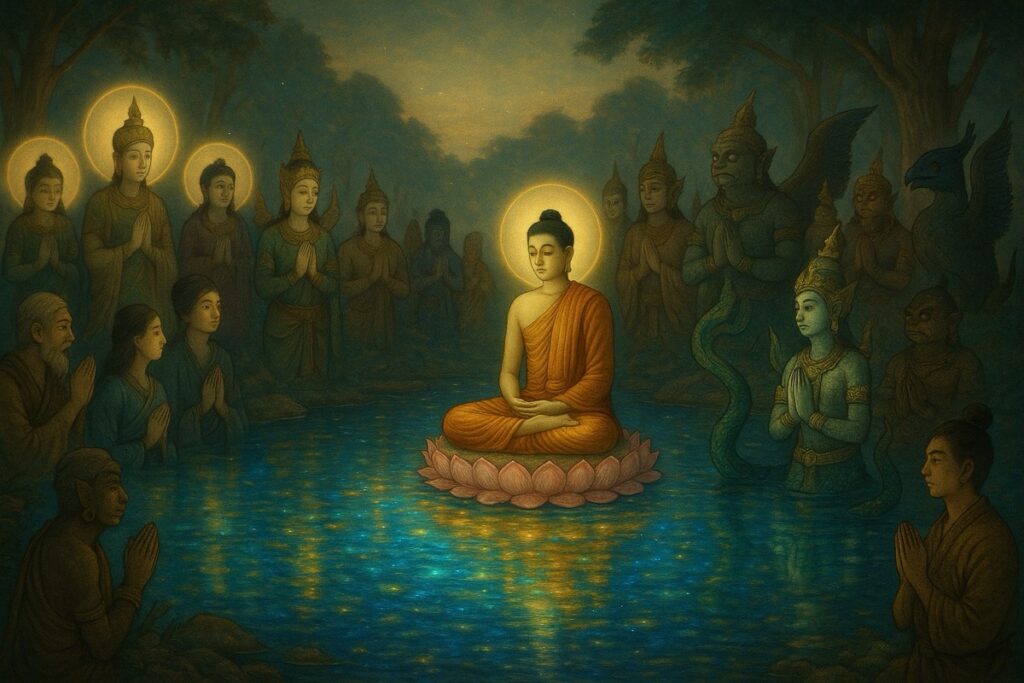
“Thus have I heard. Once, the Buddha was in the country of Magadha, in the Pure Light Illuminating Jewel Pond, surrounded by a vast assembly of great bodhisattvas, great arhats, devas, nāgas, yakṣas, gandharvas, asuras, garuḍas, kiṅnaras, mahoragas, and humans, numbering innumerable hundreds of thousands, all gathered before and after.”
“如是我闻。一时,佛在摩伽陀国,无垢园中宝光明池,与大菩萨及大声闻、天龙、药叉、犍闼婆、诃苏罗、迦楼罗、紧那罗、摩睺罗伽、人非人等,无量百千,前后围绕。“
Commentary:
This opening line—“Thus have I heard”—anchors us in a sacred memory. Not myth, not fiction, but direct oral transmission, usually from Ānanda. It places us in a time and space where the Dharma is alive and being witnessed.
We’re in Magadha, one of the Buddha’s key teaching grounds. But not just any place within it—the Pure Light Jewel Pond. Imagine a place where the water reflects wisdom, where the very light is described as “pure.” This setting is intentional. It prepares the mind for revelation.
Then comes the assembly—and it’s massive. But not just in size. In diversity. There’s everyone: great bodhisattvas and arhats (fully liberated beings), celestial gods, dragons, nature spirits, demigods, mystical bird-men, serpent kings, and humans. Each represents different karmic realms and spiritual stages.
What does this mean for us?
It means the teaching about to unfold is not for monks only. It’s not for elites. It’s for all sentient beings across time, space, and dimension. If you’re alive and breathing—this Dharma is addressed to you.
Also, the setting’s name—Jewel Pond—hints that there’s a treasure beneath the surface. A calm exterior, hiding profound depth. Which is exactly what this sutra turns out to be.
📜 2. The Appearance of the Brahmin Pure Wonderful Light
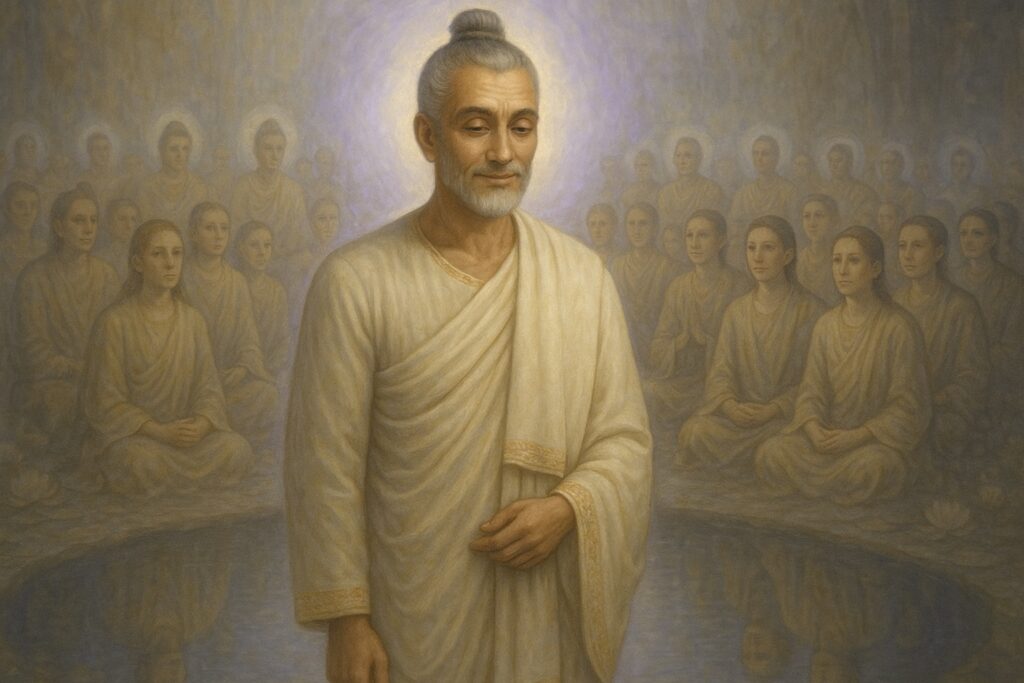
“At that time, among the assembly, there was a great Brahmin named Pure Wonderful Light. He was well-versed and intelligent, admired by people, and consistently practiced the Ten Virtuous Actions. He had deep faith in the Triple Gem, a kind heart, and subtle wisdom. He always wished to benefit all sentient beings, enriching them with great wealth and abundance.”
“尔时,众中有一大婆罗门,名无垢妙光,多闻聪慧,人所乐见,常行十善,归信三宝,善心殷重,智慧微细,常恒欲令一切众生,圆满善利,大富丰饶。”
Commentary:
This is the character we’re meant to see ourselves in—not because we’re already like him, but because he shows us what sincere aspiration looks like.
His name, Pure Wonderful Light (無垢妙光), isn’t just poetic. It’s symbolic of his essence. “Pure” suggests freedom from defilement; “Wonderful Light” suggests both insight and compassion. In other words, he’s not just good—he’s deeply aligned with Dharma.
Let’s look at his qualities:
- Well-versed and intelligent – he’s educated, but his knowledge doesn’t make him arrogant.
- Practices the Ten Virtuous Actions – moral integrity is not negotiable for him. He lives it.
- Faith in the Triple Gem – not intellectual belief, but genuine trust in the Buddha, Dharma, and Sangha.
- A kind heart and subtle wisdom – these two often don’t appear together. But here, wisdom isn’t dry—it’s gentle. It’s sensitive.
- Wishes to benefit all beings – his intention isn’t self-liberation alone. He wants others to rise with him. And not just spiritually—he prays for others to be materially abundant too. That’s real compassion.
This is the sutra’s way of telling us: You don’t need to be a monk or deity to be a vessel for the sacred. You just need a clean heart and a deep vow.
This Brahmin is the layperson’s path. He is us—but cultivated.
📜 3. The Invitation and Offering
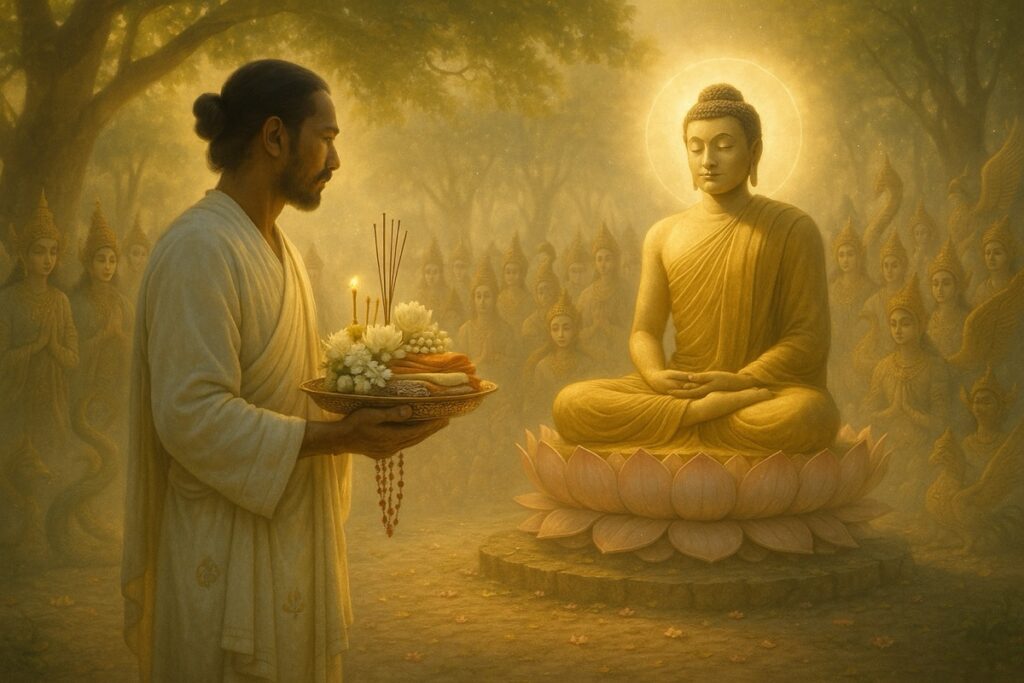
“Pure Wonderful Light rose from his seat, approached the Buddha, circumambulated him seven times, and offered various fragrances and flowers, priceless exquisite garments, necklaces, and jeweled head ornaments, presenting them to the World-Honored One. He also paid homage to the Buddha’s feet, then stood on one side and made this request, saying, ‘May the World-Honored One, together with the great assembly, come tomorrow morning to my residence to receive my offerings.’”
“时婆罗门无垢妙光从座而起,往诣佛所,绕佛七匝,以众香华奉献世尊,无价妙衣、璎珞、珠鬘,持覆佛上,顶礼双足,却住一面,作是请言:“唯愿世尊与诸大众,明日晨朝,至我宅中,受我供养。”
Commentary:
This scene might look like ritual, but at its heart, it’s pure intention put into form.
Let’s break it down:
- Rising from his seat shows readiness. He’s not passive in the presence of the Buddha. He gets up. He moves. He acts.
- Circumambulating seven times isn’t random. Seven is the number of completion in Buddhism—seven steps, seven limbs of awakening, seven directions (four cardinal, zenith, nadir, and center). This is a full-bodied gesture of reverence.
- The offerings—fragrances, flowers, garments, jewelry—might seem opulent, but they represent renunciation of ego. These are symbols of the world’s beauty, and he gives them up, not because they’re bad, but because they’re not the point. He’s offering up what he values most.
Then comes the actual invitation.
Imagine the scene: in front of celestial beings and awakened masters, he invites the Buddha and the entire assembly to his house. Not to impress. Not for status. But to host the Dharma.
This is a layperson’s highest act: inviting the Buddha into one’s life, into one’s home, into one’s daily world. In a modern context, this would be like saying, “I want the truth not just in my temple visits—but in my kitchen, in my office, in my living room.”
This is where spiritual sincerity meets hospitality.
📜 4. The Buddha’s Silent Consent
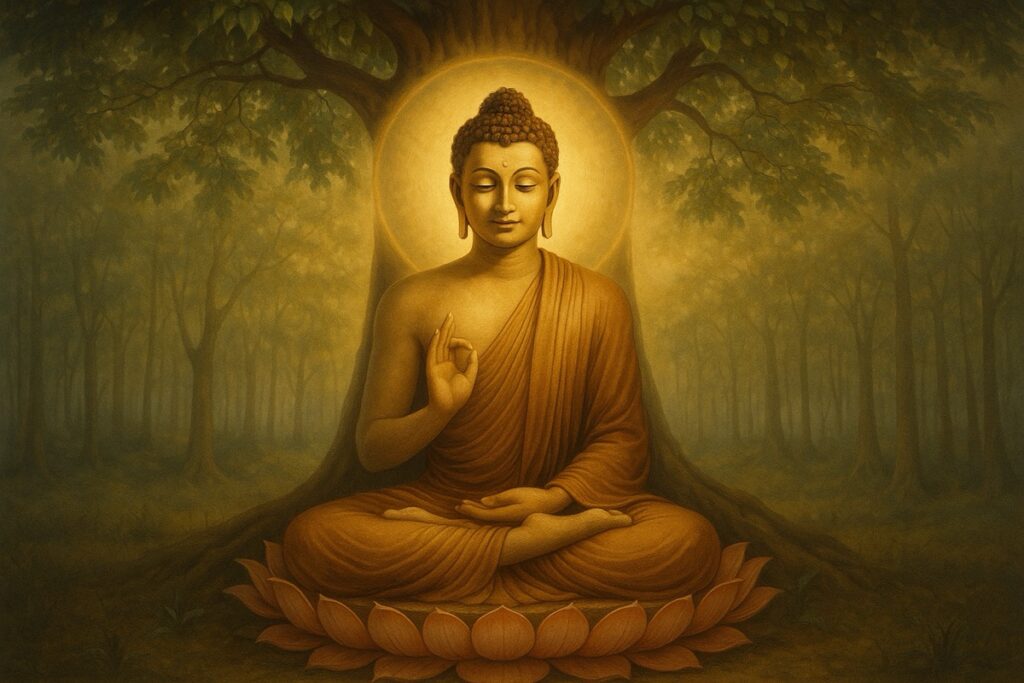
“At that moment, the World-Honored One silently consented.”
“尔时世尊,默然许之。”
Commentary:
No thunderclap. No heavenly proclamation. Just silence.
In a Western context, silence is often seen as awkward, as absence. But in Buddhist teachings, especially in Mahāyāna sutras, silence is presence.
This is a moment of profound acknowledgment. The Buddha doesn’t need to say “Yes.” His silent consent carries a deeper kind of affirmation—one that arises from mind-to-mind transmission. A resonance that doesn’t require sound. Think of it like a tuning fork—Pure Wonderful Light’s sincerity rings so clearly that the Buddha simply echoes it with stillness.
But there’s also a deeper message here:
When our intent is pure, the Dharma responds.
When our actions align with compassion, even the universe listens in quiet affirmation.
You could also say this moment illustrates a spiritual truth: sometimes, the clearest “yes” in life won’t come with applause—it will come with peace.
The Buddha’s stillness is the ultimate go-ahead.
📜 5. The Night of Preparation and the Buddha’s Journey
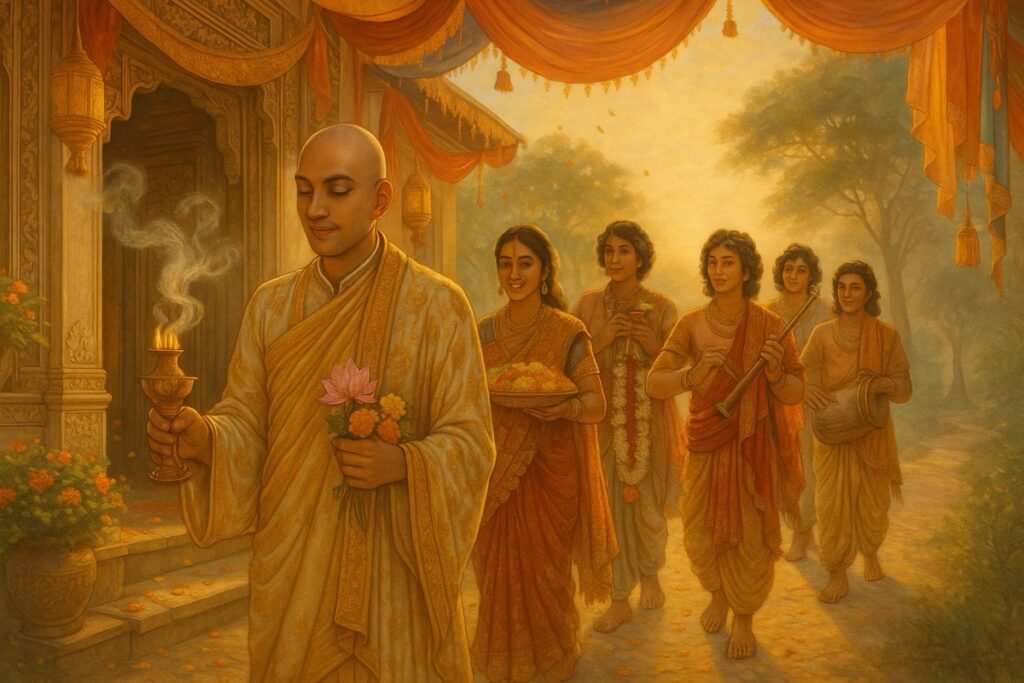
“When the Brahmin Pure Wonderful Light knew that the Buddha accepted his invitation, he immediately returned to his dwelling and prepared a sumptuous feast with a variety of delicacies and drinks. He cleansed and adorned his hall, and set up banners and canopies. When the next morning arrived, he, along with his family and attendants, holding various fragrances and flowers, as well as musical instruments, proceeded to where the Buddha was and requested his presence, saying, ‘Please come, O World-Honored One.’”
“时婆罗门知佛受请,遽还所住,即于夜间,广办肴膳,百味饮食,洒扫殿宇,张施幡盖。至明旦已,与诸眷属,持众香华及诸伎乐,至如来所,白言:“时至,愿垂降临。”“
Commentary:
This isn’t just hosting. This is offering the world.
The moment the Buddha silently consents, Pure Wonderful Light doesn’t waste a second. He returns home and transforms it—not into a lavish palace, but into a worthy space for the Dharma.
It’s significant that he prepares all this through the night. That shows the urgency and sincerity of his devotion. The darkness of night becomes a canvas for his practice. He sweeps, decorates, cooks. Every action is a prayer. Every corner he cleans is a reflection of his inner clarity.
The food he prepares isn’t named in detail—but it says “hundreds of flavors.” That’s symbolic. It represents the fullness of life—the entire spectrum of taste and experience—all laid out as an offering.
Then morning comes, and with it, his entourage of family and helpers, bearing flowers, incense, and music. Imagine the scene: a quiet dawn, and this caravan of fragrance and sound making its way toward the Buddha. No subtlety. No shame in devotion.
He doesn’t just say, “I hope he comes.” He goes to get him—not as a demand, but as an act of reverent welcome.
If you’ve ever cleaned your home like a temple or prepared a meal hoping to feed something beyond the stomach—you’ve touched this same spirit.
📜 6. The Buddha Rises and Radiates Light
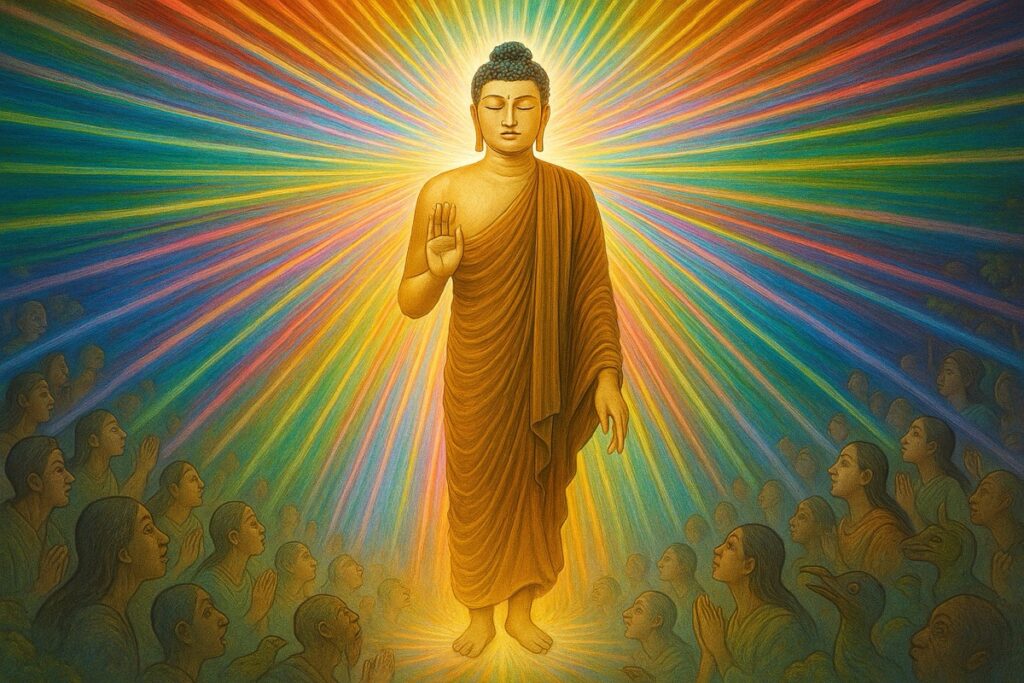
“Then, the World-Honored One gently consoled the Brahmin Pure Wonderful Light and said to the great assembly, ‘You should all go to the house of this Brahmin to receive his offerings. This will bring him great benefit.’ At that moment, the World-Honored One rose from his seat.
As soon as he rose, multicolored rays of light emanated from his body, intricately woven in brilliance, illuminating the ten directions and awakening all beings. Then the Buddha proceeded on his way.
The Brahmin, with utmost reverence, carrying fine incense and flowers, led the way with his family, celestial beings, the Eight Classes of Beings, and the Four Heavenly Kings, clearing and preparing the path, guiding the Tathāgata.”
“尔时,世尊软语安慰彼婆罗门无垢妙光,遍告大众宣言:“汝等皆应往彼婆罗门家摄受供养,为欲令彼获大利故。”于时世尊即从座起,才起座已,从佛身出种种光明,间错妙色,照触十方,悉皆警觉,然后趣道。时婆罗门以恭敬心,持妙香华,与诸眷属及天龙八部、释梵四王,先行治道,奉引如来。”
Commentary:
This passage might look like a ceremonial moment, but it’s loaded with cosmic implications.
Let’s start with how the Buddha consoles the Brahmin. Not with grand words, but with soft speech. That gentleness, that kindness, is already a form of blessing. It says: “Your sincerity is seen. Your offering is worthy.”
Then comes the command to the entire assembly—devas, dragons, monks, bodhisattvas—basically the who’s who of spiritual beings. Everyone is told to go not because the Buddha needs food, but because accepting this offering will bring immense merit to the host. That’s a huge theme in Buddhism: the act of giving benefits the giver more than the receiver. Especially when it’s done with sincerity and reverence.
And then—what a moment—the Buddha stands. That simple action becomes an event. Light of countless hues bursts from his body. Not just golden beams, but a mix of radiant colors, each representing different virtues: compassion, wisdom, purity, strength, and peace. They don’t just shine—they touch the ten directions. They awaken beings. Even those far away, deep in distraction, are stirred.
It’s the Dharma in motion. The Enlightened One doesn’t just walk. His journey transforms space.
The Brahmin? He’s not idle. He moves with deep humility, leading the way, holding incense and flowers—not because it’s expected, but because reverence must express itself. And here’s the beautiful detail: he’s not alone. He’s accompanied by celestial kings, dragon deities, and others who clear the road—not in a militaristic way, but in a sacred procession. Imagine the atmosphere: bells from the heavens, flower petals in the air, silence broken only by chants and flutes.
This is the path of devotion meeting the path of the Dharma.
And the entire universe bows in response.
📜 6. The Buddha’s Journey and the Discovery of the Ruined Stupa
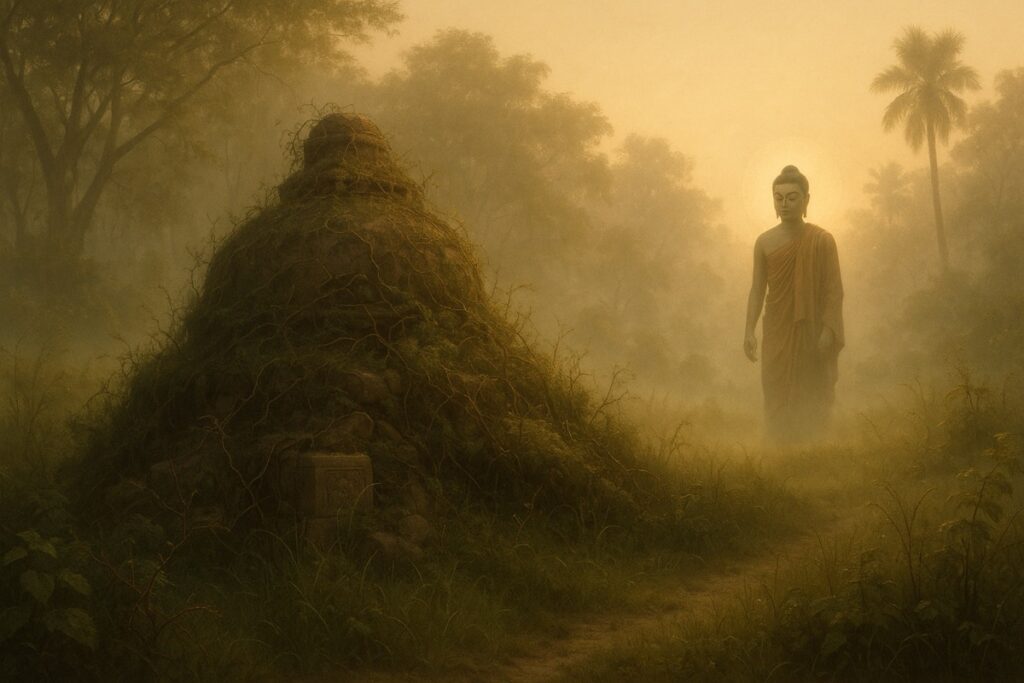
“As the World‑Honored One proceeded not far from the assembly, he arrived at a garden called Abundant Wealth. In that garden was an ancient, dilapidated stupa, collapsed and overgrown with thorns, entangled with vines, and covered with grass. It appeared like a mound of earth.”
“尔时世尊前路不远,中至一园,名曰丰财。于彼园中有古朽塔,摧坏崩倒,荆棘掩庭,蔓草封户,瓦砾埋隐,状若土堆。”
Commentary:
So here’s what happens next: the Brahmin’s morning procession is going great—everyone’s dressed up, the sky is gold with dawn, music’s playing, the fragrance of incense is in the air. It’s one of those “everything is perfect” mornings.
But the Buddha? He stops.
He turns off the “main route” and walks into a place called Abundant Wealth Garden—which, ironically, holds something that looks the exact opposite of wealth: a collapsed, thorn-covered, overgrown heap of a stupa. It’s not majestic. It’s not glowing (yet). It’s literally mistaken for a mound of dirt.
But the thing is… this moment changes everything.
The Buddha walks toward it. No one else sees its importance. And I love that, because that’s how Dharma works sometimes. What we think is trash? That’s where the teaching lives. What’s been buried under years of dust, pain, or forgetfulness? That’s where we find relics.
And that garden name—Abundant Wealth—feels like a cosmic joke. Because we’re reminded that sometimes the most valuable treasures are lying in plain sight, completely ignored. Not because they’re lost, but because we forgot how to see them.
This scene is subtle, but it’s a turning point. The Buddha’s detour is a detour for the whole story. This isn’t just about offerings anymore. Something buried is about to wake up.
📜 7. The Stupa Speaks and the Buddha Weeps
“At that moment, a radiant light shone forth from the stupa, illuminating brilliantly, and within the mound of earth, a voice proclaimed: ‘Excellent! Excellent! Śākyamuni, today you perform extremely virtuous actions. Moreover, Brahmin, you will gain great benefits today.’”
“The World-Honored One paid homage to the decaying stupa, circumambulated it three times, removed his upper garment, spread it over the stupa, and with tears streaming down like rain, tears and blood flowing together, he wept, and then smiled.”
“尔时世尊迳往塔所,于时塔上放大光明,照耀炽盛,于土聚中出声赞言:“善哉!善哉!释迦牟尼,今日所行极善境界。又婆罗门,汝于今日获大善利。”
尔时世尊礼彼朽塔,右绕三匝,脱身上衣,用覆其上,泫然垂泪,涕血交流,泣已微笑。“
Commentary:
Then it happens.
Out of that ragged pile of dirt and vines comes light. Pure, radiant, otherworldly light. And then—a voice. No face, just a proclamation from the earth itself: “Excellent! Excellent! Śākyamuni, today you perform extremely virtuous actions…”
Now pause for a second.
That voice doesn’t just praise the Buddha. It praises the Brahmin too. That’s a huge detail. It means the devotion of an ordinary person—someone with a sincere, open heart—helped trigger a cosmic awakening. You can’t read that and not feel something.
Then, in a deeply human moment, the Buddha walks to the ruined stupa, takes off his upper robe, and places it over the heap—a gesture of supreme reverence. And then?
He cries.
Not a single tear down the cheek moment. He weeps. The text says “tears and blood flowed together.” That’s a level of emotion we almost never see in sutras. And then—he smiles.
This is one of those deeply paradoxical, painfully beautiful moments.
He’s mourning, yes—but also acknowledging. The smile isn’t happiness. It’s the quiet recognition that even when the Dharma is forgotten, it’s never lost.
Someone remembered. The light still shines. The voice still speaks.
This scene is my favorite. It’s honest. It tells us that even the Buddha isn’t immune to grief—not when it comes to the Dharma being neglected. But he’s also not without hope. That’s the lesson: sorrow and clarity can exist in the same breath.
📜 8. The Buddhas Appear and the Assembly Is Shaken
“At that time, all the Buddhas from the ten directions, as well as innumerable bodhisattvas, also shed tears, all appearing before him. Then, the great assembly was astonished and perplexed, and they sought to dispel their doubts.”
“The Bodhisattva Vajrapāṇi and others, also shedding tears, their radiance blazing, wielding their vajras, approached the Buddha and said, ‘World-Honored One, what is the reason for this light manifestation? Why does the Tathāgata shed tears, and why do all the Buddhas display such auspicious light? Please explain this mystery to us.’””当尔之时,十方诸佛,皆同观视,亦皆流泪,各所放光来照是塔。于时大众惊愕变色,互欲决疑。尔时,金刚手菩萨等,亦皆流泪,威焰炽盛,执杵旋转,往诣佛所,白言:“世尊!此何因缘,现是光相?何如来眼流泪如是?亦彼十方诸佛大瑞光相现前?唯愿如来于此大众解释我疑。“
Commentary:
So here’s the setup: the Buddha has just wept at a ruined stupa. His robe is draped over it like a sacred blanket. He’s cried, smiled, and basically turned this forgotten mound of earth into the emotional center of the entire universe.
And then… everything responds.
Suddenly, from all directions—ten directions to be exact—Buddhas start appearing. Not one or two. Not a dozen. We’re talking limitless Buddhas from countless realms. They’re not just showing up casually either.
They’re crying.
Let that sink in for a sec.
We usually picture Buddhas as these unmoved, serene figures sitting in full lotus, eyes half-closed, glowing like a soft lamp. But now they’re appearing with tears in their eyes. Because what the Buddha just touched—the pain of Dharma being forgotten, the joy of it being remembered—is something every awakened being feels.
It’s a ripple through the entire Dharma universe.
And it doesn’t stop there. The whole assembly—Bodhisattvas, Devas, Nāgas, celestial warriors—they all feel it too. But they don’t understand it. Even they are left standing there going, “Wait… what just happened?”
This is where I really love the storytelling. Because in the middle of all this cosmic drama, someone finally breaks the silence.
Enter Vajrapāṇi.
He’s no quiet monk. Vajrapāṇi is the thunderbolt-wielding protector—the one who usually stands at the door looking fierce and unshakeable. But even he’s crying. Even he feels it in his bones.
And what does he do? He asks. Straight-up asks the Buddha: “Why the light? Why the tears? What’s happening here?”
And that’s such a human moment.
Because sometimes we see something sacred or overwhelming and we don’t get it—we just know it means something. So we ask. And Vajrapāṇi’s question isn’t a challenge. It’s reverence in the form of curiosity.
It’s like saying, “Please, show us the heart of this moment.”
And soon, the Buddha will answer.
📜 9. Awakening Begins and the Buddha Drops a Dharma Bomb
“When the multitude heard the Buddha’s words, they shunned dust and filth [their afflictions] and acquired the pure dharma-eye. Because the capacities of the multitude were so varied, each received a different benefit. Some became Pratyekabuddhas; some achieved voice-hearer fruits, becoming Srotāpannas, Sakṛdāgāmins, Anāgāmins, or Arhats. On the Bodhisattva Way, some achieved the level of avinivartanīya or acquired sarvajña; some attained the First Ground, Second Ground, or even the Tenth Ground; and some fulfilled the six pāramitās. The Brahmin shunned dust and filth [his afflictions], and acquired the five transcendental powers.”
“Witnessing these unprecedented occurrences, Vajrapāṇi exclaimed, ‘World-Honored One, how wonderful and how extraordinary! If people acquire such excellent merit by merely hearing about this matter, how much more merit will they acquire if they hear the profound truth and elicit their faith with an earnest mind?’”
“The Buddha replied, ‘Hearken! Vajrapāṇi. In future times, if, among male believers, female believers, and my four groups of disciples, there are those who are inspired to copy this sūtra, they in effect copy all the sūtras pronounced by 99 billion koṭi Tathāgatas… All Buddha-Tathāgatas, who are as numerous as the sands of the Ganges, will come… like sesame seeds in a pile… incessantly, they come again as soon as they turn away.’”
“尔时大众闻佛是说,远尘离垢,断诸烦恼,得法眼净。时众机异,利益亦别。须陀洹果、斯陀含果、阿那含果、阿罗汉果、辟支佛道,及菩萨道、阿鞞跋致、萨波若智,于如是事,各得其一;或有证得初地、二地,乃至十地;或有满足六波罗蜜。其婆罗门远尘离垢,得五神通。时金刚手见此奇特希有之事,白言:“世尊!妙哉奇异,但闻此事,尚获如是殊胜功德,况闻深理,至心起信,得几功德?”
佛言:“谛听!汝金刚手,后世若有信男、信女,及复我等四部弟子,发心书写此一经典,即准书写九十九百千万俱胝如来所说一切经典;即过于彼九十九百千万俱胝如来之前,久植善根;即亦彼诸一切如来,加持护念,犹如爱眼,亦如慈母,爱护幼子。“
Commentary:
This passage feels like the Dharma equivalent of fireworks going off in the middle of a monastery.
The Buddha finally speaks, and just from his words alone—just the sound of truth being spoken—people start waking up left and right. Some gain clarity like the sun cutting through fog. Some hit stream-enterer level immediately. Others shoot up to Arhat or Bodhisattva stages. One guy hits the First Ground, another is already chilling on the Tenth. And our Brahmin? He goes full Jedi mode—gaining the five transcendental powers.
But here’s what’s brilliant: the Buddha doesn’t say, “Good job, you’ve reached enlightenment.” He shifts the focus from attainment to transmission.
He says if you copy this sūtra, just that act alone is as if you’ve transcribed every word ever spoken by 99 billion Buddhas. I mean—can you even wrap your head around that?
And it’s not just symbolic. He’s saying that the spiritual weight of engaging with this text directly pulls you into the orbit of every enlightened being who’s ever lived. You’re not reading alone. You’re chanting in the presence of an interdimensional Buddha swarm.
They come jam-packed, shoulder to shoulder, like sesame seeds—no space between them. They don’t arrive and leave politely. They flow in, whirl around, disappear, and return again instantly like sand in rushing water.
And if someone offers even a stick of incense or a single flower to this sūtra? It’s like making a Mount Sumeru–sized offering to all the Buddhas in all ten directions, all at once.
I love that the crowd includes gods, dragons, non-humans, and they’re all looking at this dusty hill thinking, “Dude, this is insane.” One minute it’s a lump of overgrown dirt, the next it’s lighting up the Dharma realm.
The takeaway? We don’t need to look for magic in distant heavens.
Sometimes it’s right beneath our feet, disguised as an old pile of forgotten earth. Hearing it transforms, copying it empowers, valuing it connects you with boundless awakening
📜 10. Why It Looks Like Earth and Yet Stands Forever
“The Buddha replied to Vajrapāṇi, ‘This is not a heap of earth; it is a wondrous and magnificent great pagoda! Due to the inferior karmic fruits of sentient beings—because of our delusion, forgetfulness, and bad habits—it remains hidden and not visibly manifested. Because it is concealed, the Buddha’s complete body cannot be destroyed. How could the Buddha’s body, protected by the adamantine treasury, be subject to destruction? Even if I pass into Nirvana, and in future times of Dharma decline when beings follow wrongful practices, fall into hell, lack faith in the Triple Gem, and fail to cultivate good roots due to such circumstances—the Buddha’s teachings will become obscured. Nevertheless, this pagoda will remain firm and indestructible, supported by the power of all the Buddhas. Though ignorant sentient beings are obscured and deluded, they disregard the precious treasures; because of this, I am shedding tears, and the other Buddhas also shed tears.’”
“佛告金刚手:“此非土聚,乃是殊妙大宝塔耳!由诸众生业果劣故,隐蔽不现。由塔隐故,如来全身非可毁坏,岂有如来金刚藏身而可坏哉!我若灭度,后世末法逼迫之时,若有众生习行非法,应堕地狱,不信三宝,不植善根,为是因缘,佛法当隐,然犹是塔坚固不灭,一切如来神力所持。无智众生惑障覆蔽,徒朽珍宝,不知采用,以是事故,我今流泪,彼诸如来,亦皆流泪。”“
Commentary:
This verse hits like a spiritual mic drop:
- “Not a heap of earth”—the Buddha clarifies right off the bat. Under that dust and vines is something eternal.
- The real villain here isn’t time or nature—it’s our own karma. Our collective distractions, spiritual laziness, and forgetfulness buried this stupa. And yet, like an underground spring, its essence never stopped flowing.
Here’s the paradox:
Though the Dharma may get obscured, it’s never destroyed. Even in the darkest age—the era of Dharma decline—when people don’t believe, don’t practice, and fall into chaos, this pagoda won’t crumble. It will stay standing. Why? Because it’s held up by the power of all Buddhas.
That’s why the Buddha cried earlier. Not because he saw decay, but because he knew the truth—that even sacred things get buried when we lose sight. He shed tears for the Dharma’s haze, and the other Buddhas echoed that emotion.
This isn’t a warning; it’s a wake-up call.
It’s like the universe is whispering: “Something holy stands right in front of you—don’t let it disappear into your own oblivion.”
And it isn’t just physical. It’s symbolic, too. We don’t need to wait for the future to get “Dharma dark.” We each carry small stupas in our hearts—practices, vows, daily devotions—that can rot if we stop caring. But this verse tells us they’re still there. Not just that—they’re ironclad.
📜 11. Turning Towers into Dharma Engines
“Furthermore, the Buddha told Vajrapāṇi, ‘If there are sentient beings who write down this scripture and place it inside a stupa, that stupa will be the Vajradhātu Stupa of all the Tathāgatas. It will also be the stupa empowered with all the Tathāgatas’ secret and profound Dhāraṇīs. It will be the Vajradhātu Stupa of the ninety-nine billion Tathāgatas, and it will also be the stupa of all the Tathāgatas’ crowns and eyes. It will be protected by all the Tathāgatas’ spiritual powers. If this scripture is placed in a Buddha image or inside a stupa, the image will be made of the seven precious substances, fulfilling all wishes and desires. The stupa will have umbrellas, nets, wheels, canopies, the ‘OM’ syllable, bells, and bases, all according to the practitioner’s capabilities, made from earth, wood, stone, or brick. Due to the power of this scripture, the stupa itself will transform into the seven precious substances. All the Tathāgatas will empower this scripture, unceasingly blessing it with their truthful words.’”
“复次,佛告金刚手言:“若有众生书写此经置塔中者,是塔即为一切如来金刚藏窣都婆,亦为一切如来陀罗尼心秘密加持窣都婆,即为九十九百千万俱胝如来窣都婆,亦为一切如来佛顶佛眼窣都婆,即为一切如来神力所护。若佛像中、窣都婆中安置此经,其像即为七宝所成,灵验应心,无愿不满。其窣都婆,伞盖罗网,轮橖露盘,德字铃铎,楹础基阶,随力所办,或土或木,若石若砖,由经威力,自为七宝。一切如来于此经典加其威力,以诚实言不断加持。”
Commentary:
Okay. This is the verse where the sacred gets practical.
Up till now, we’ve been swimming in deep symbolic water—relics, mantras, visions, tears. But now? The Buddha’s saying, “You want to preserve this? You want to bring this to life? Here’s how.”
And it starts with a pen and a page.
Just writing this sutra down, then placing it inside a stupa, turns that stupa into a full-on Vajradhātu powerhouse. Not just a monument, not a statue with good vibes. It becomes a generator of Dharma energy, radiating the blessings of 99 billion Buddhas.
The math here isn’t literal—it’s cosmic scale language. It’s the sutra’s way of saying: “All Buddhas are present in this. Not symbolically. Fully. Actively.”
Now let’s get wild: If you place this inside a Buddha image, that statue transforms. It’s no longer wood or clay or gold—it becomes alive with the essence of all the Buddhas, forged in seven precious substances—not because of materials, but because of meaning.
And the best part? It’s not about perfection.
The stupa can be made from wood, stone, mud, or brick—whatever the practitioner can manage. The Dharma doesn’t ask you to be rich. It asks you to be sincere.
The transformation isn’t aesthetic—it’s energetic. Because of the power of the dhāraṇī, everything becomes sacred. The structure becomes a channel. A mirror of enlightenment. And the Buddha says straight up: the Tathāgatas themselves will empower and protect it, day and night, through truthful vow.
So the message here is direct: “Don’t just read this. Build something. Place it inside. And let the Dharma live beyond your breath.”
📜 12. One Flower, One Bow, Eighty Billion Eons of Karma—Gone
“If sentient beings offer even one incense stick or one flower in homage to this stupa, the heavy negative karma accumulated over eighty billion eons will be eradicated in an instant. They will be free from calamities and afflictions, born into the family of Buddhas in this life and the next. If anyone is destined to fall into Avīci Hell, but they offer a single homage or circumambulation to this stupa, they will close the gates of hell and open the path to enlightenment. Wherever this stupa or its image is, it will be protected by the spiritual powers of all the Tathāgatas…”
“若有有情能于此塔,一香一华礼拜供养,八十亿劫生死重罪一时消灭,生免灾殃,死生佛家。若有应堕阿鼻地狱,若于此塔或一礼拜,或一右绕,塞地狱门,开菩提路。“
Commentary:
Alright. This is where the power level of this sutra goes full supernova.
It starts simple. Offer one flower. Burn one incense stick. We’re not talking elaborate ceremonies here—this is entry-level devotion. But what happens?
Boom. Eighty billion eons of karma? Wiped.
That’s like snapping your fingers and erasing every bad decision in your past lives combined. Your unpaid karmic debt? Cleared like it got hit with divine bankruptcy protection.
Now imagine you’re someone truly stuck—destined for Avīci Hell, the lowest and most terrifying realm in Buddhist cosmology. Just one bow, one walk around the stupa, and suddenly—poof—the gates of hell slam shut, and the doors to enlightenment swing wide open.
And it doesn’t stop there. The stupa isn’t just a karma-erasing vending machine. It’s also a safe zone, protected 24/7 by the spiritual energy of every Tathāgata. No storms, lightning, poison, beasts, or spirits can harm it. This is the ultimate spiritual firewall.
But here’s the deeper layer. Why does such a small act—one flower, one bow—generate such huge merit?
Because what you’re connecting with isn’t just a statue or a structure. You’re tapping into the collective enlightenment of infinite Buddhas, funneled into this physical anchor. That one gesture is like plugging your soul into the Dharma grid.
And the kicker?
“Born into the family of Buddhas.”
Not a better rebirth. Not just less suffering. You actually start aligning your life trajectory with enlightenment itself.
In short: you don’t need to be perfect. You just need to show up—with sincerity. That’s what this point is screaming: show up. Just once. Just honestly. And everything shifts.
📜 9. The Revelation of the Sacred Dhāraṇī
“At that moment, the World-Honored One uttered the Dhāraṇī, saying:”
“尔时世尊即说陀罗尼曰:”
Namas, triya-dhvikānām – “Homage, to the threefold divisions [the Three Bodies or Tri-kaya].” A bow to the ultimate reality manifesting in different forms.
Sarva, tathāgatanām – “To all Tathāgatas (Fully Awakened Ones).” This reminds us the mantra connects us to every Buddha.
Om, bhuvi, bhavadha, vare, vachale, vachatai – “Om, earth, becoming, excellent, immovable, unshakeable, supreme.” Invoking stability and transcendence on every level.
Suru, suru, dhara, dhara – “Arise, arise; support, support.” A call for awakening and sustaining the Dharma.
Sarva, tathāgata – “All Tathāgatas.” Reinforcing the lineage and unity with the awakened ones.
Dhātu, dhare, padma-bhavati – “Possessing the relics; becoming like a lotus.” Lotus symbolizes purity; we too become clear and radiant.
Jaya, vare – “Victory, excellence.” Celebrating spiritual triumph and supreme virtue.
Mudre, smara – “Seal (symbolic imprint), mindfulness.” We hold the Dharma in our hands and hearts.
Sarva, tathāgata, dharma, cakra, Pravartana – “All Tathāgatas, turn the Dharma Wheel.” A nod to the Buddha’s teaching and its ongoing motion.
Vajra, bodhi, manda – “Diamond-like awakening.” Unbreakable wisdom shines through.
Rumkāra, Rumkirte – Phrases that evoke spiritual resonance—rare, auspicious vibrations.
Sarva tathāgata dhistite – “Established by all Buddhas.” We stand firm in a universal foundation.
Bodhaya, bodhaya – “Awaken, awaken.” An echo urging us toward full enlightenment.
Bodhi, bodhi – “Awakening, awakening.” Rooting deeply in awakened truth.
Buddhya, buddhya – “By Buddhahood.” Acknowledging the awakened state.
Sambodhani, sambodhaya – “Universally awakened, universally enlightening.” Our goal is full awakening for all.
Chala, chala, Chalantu – “Move, move, let [possession] flow.” We invite the Dharma’s transformative forces.
Sarva, varanāni – “All protections.” We call in blessings and safeguard.
Sarva, pāpa, vigate – “All sins cleared.” Letting go of past burdens.
Huru, huru – A vibrational unlock—like a cosmic key turning.
Sarva, sukha, vighāti – “Remove all suffering.” Releasing pain and obstacle.
Sarva tathāgata, Hridaya, vajrāṇi – “All Buddhas’ hearts are diamond-like.” The core of compassion and clarity is indestructible.
Sambhara, sambhara – “Accumulate, accumulate.” We build merit and virtue.
Sarva tathāgata, Suhaya, dhāraṇi, mudre – “All Buddhas’ auspicious mantra seal.” We seal blessings with the mantra.
Buddhi, subuddhi – “Wisdom, great wisdom.” Our intention is uplifted with clarity.
Sarva tathāgata dhistita – “Held by all Tathāgatas.” We are supported by the awakened.
Dhātu garbhe svāhā – “In the womb of relics—so be it.” A consecration as sacred as relics themselves.
Samaya dhistite svāhā – “In commitment established—so be it.” Our vows are sealed.
Sarva tathāgata hridaya dhātu mudre svāhā – “Praise to the heart relic seal of all Buddhas.” Centering devotion on the Buddha-heart mantra.
Supra tisthita stūbhe tathāgata dhistite – “In the exalted stupa, established by all Buddhas.” The mantra grounds itself in sacred space.
Huru huru hum hum svāhā – Sound of release and blessing. A cleansing, empowering chant.
Om sarva tathāgata – Om, all Buddhas. A cosmic invocation.
Uṣṇīṣa dhātu mudrāṇi sarva tathāgatam sad-dhātavi bhūṣita dhistite – “The Uṣṇīṣa (crown protuberance), relic seals of all Buddhas, blessed and established.” Signifies the crowned wisdom of every Buddha.
Hum hum svāhā – A final seal: the hum of awakening, the sacred assurance.
Commentary:
This isn’t just a chant. It’s the spiritual DNA of every Buddha, crystallized in sound.
Up until this moment in the sutra, the Buddha has described the power of this hidden stupa, how it holds the entire body relics, the storehouse of all teachings, the crowns and seals of countless Buddhas. And now—he opens it.
And what comes out?
Not a sermon.
Not a debate.
But a dhāraṇī.
A sacred formula that’s not meant to be “understood” in a rational way, but activated through sound, vibration, and repetition. This is what connects your mind to the minds of all Tathāgatas.
The moment the Buddha speaks this mantra, it becomes available. Not just to the crowd in front of him, but to you, me, your great-grandmother in the afterlife, that guy in a traffic jam wondering what his life means. Everyone.
Why? Because it’s designed to carry the power of the Three Bodies:
- The Dharmakāya – truth itself.
- The Sambhogakāya – blissful form seen by advanced meditators.
- The Nirmāṇakāya – the Buddha’s manifested form here in the world.
All of that is encoded in this one chant.
📜 13. When Even the Mosquito Gets Enlightened
“If a sparrow, an owl, a dove, a vulture, a dog, a wolf, a mosquito, a gnat, or any other similar creature happens to pass by the shadow of the stupa or walk across its surroundings, their delusions will be shattered, and they will awaken from ignorance, revealing their inherent three kinds of Buddha nature. Eventually, they will abide in great Nirvana.”
Commentary:
Okay—this one gives me goosebumps every time.
We’ve seen the power of recitation, of offerings, of building stupas. But now, the Buddha’s telling us something even more radical:
You don’t even have to intend to connect with this Dharma.
You just need to brush up against it.
A mosquito lands on the grass near the stupa. A stray dog walks through the area. A crow flies through its shadow. And suddenly—karmic veils rip open. These beings, who probably don’t even know the stupa exists, get a blast of Dharma straight to the soul.
Their delusions are shattered.
Their ignorance gets peeled back.
And deep inside, their innate Buddha nature begins to flicker to life.
That’s huge. We’re talking about the three kinds of Buddha nature awakening:
- The potential for awakening already present within them.
- The wisdom that sees reality as it truly is.
- The capacity to embody Dharma through action.
That’s not just spiritual potential. That’s the blueprint of enlightenment activating, and it started just from proximity. No chants. No rituals. Just being near.
This turns the stupa into a kind of compassion explosion zone. Like a Dharma EMP—anything that enters the field gets rewired, lifted, purified. Even the smallest creatures. Even ghosts. Even the most forgotten of beings.
And what does this mean for us?
It means the impact of your practice is way bigger than you think. You might not see the results. You might never know that your little roadside stupa or your quiet morning chant just pulled a bat out of the lower realms.
But it’s happening.
This isn’t mythology. It’s mystic ecology. Your practice ripples outward. Into the air, the ground, the lives around you—seen and unseen.
And that, right there? That’s the kind of sacred I can believe in.
📜 14. The Blessing Transfer Effect: Dharma by Association
“If someone stays on a high mountain peak, chants the sacred incantation wholeheartedly, and allows their eyes to extend their reach, far and near, throughout the world—mountains, valleys, forests, rivers, lakes, and seas—and if all living beings, from the smallest to the largest, including those with hair, feathers, scales, and shells, are touched by this incantation’s influence, their delusions will be shattered, and they will awaken from ignorance, revealing their inherent three kinds of Buddha nature, ultimately dwelling in the vast realm of great Nirvana.”
“If one of those individuals who chant the incantation happens to pass by the same road, touches someone’s clothing, steps on their footprints, or merely sees their face or exchanges a few words with them, all the sins and hindrances of those individuals will be eradicated, and their karmic debts will be entirely fulfilled.”
“若人往在高山峰上,至心诵咒,眼根所及,远近世界,山谷林野,江湖河海,其中所有毛羽鳞甲一切生类,碎破惑障,觉悟无明,显现本有三种佛性,毕竟安处大涅槃中。若与此人往过道路,或触衣风,或踏其迹,或唯见面,或暂交语,如是等人重罪咸灭,悉地圆满。”
Commentary:
This one’s for anyone who’s ever doubted whether their practice really matters.
The Buddha basically says, “Yeah, it does—but not just for you.”
Picture this: You’re on a mountaintop. Alone. Chanting the mantra with your whole heart. And just by the sound of your voice, or even the sight of your gaze, waves of invisible Dharma energy flood the landscape.
Forests. Lakes. Creatures big and small. Even shellfish.
All of them receive a spiritual reboot. Their confusion starts to crack. The fog lifts. They get a glimpse of their own enlightenment potential.
But here’s the real kicker:
Even people who just happen to cross your path—who brush against your clothes, walk in your footsteps, or share a few words—have their karmic burdens lifted.
Think about that.
You don’t need to preach. You don’t need to teach. You don’t need to convert anyone.
Just being on the path—just carrying that vibration—is already medicine for the world.
It’s the spiritual equivalent of leaving a fragrance behind in the room after you’ve left. You don’t have to say anything. People just feel lighter after being around you.
And it’s not because you are great.
It’s because the mantra is.
You’ve become a conduit, and the transmission flows through you to others. The Buddha says their sins are wiped, their debts cleared, just from that moment of contact.
This flips the script on the whole idea of selfish practice. You’re not just meditating for your own peace. You’re becoming a blessing in motion—for anyone and anything that crosses your path.
And really… isn’t that the kind of practitioner we all want to be?
📜 15. Dharma Transmission and the Sacred Trust
“At that moment, the Buddha said to Vajrapāṇi, ‘Now I entrust you and others with this secret and sacred incantation scripture. Respect and protect it, propagate it in the world, and do not let the transmission to sentient beings be cut off.’”
“Vajrapāṇi replied, ‘I am fortunate to receive the Buddha’s entrustment. I vow to repay the deep kindness of the World-Honored One by protecting and propagating this teaching day and night, spreading it throughout all realms. If any beings write, uphold, and constantly remember this incantation, I will command the Four Heavenly Kings and the eight classes of dragon gods to protect them day and night without any interruption.’”
“The Buddha praised Vajrapāṇi, saying, ‘Excellent, Vajrapāṇi! For the great benefit of all future sentient beings, you shall safeguard this teaching to prevent its discontinuation.’”
“尔时,佛告金刚手言:“今此秘密神咒经典付嘱汝等,尊重护持,流布世间,不令众生传受断绝。”
金刚手言:“我今幸蒙世尊付嘱,唯愿我等为报世尊深重恩德,昼夜护持,流布宣扬一切世间。若有众生书写受持、忆念不断,我等麾催释梵四王、龙神八部,昼夜守护,不暂舍离。”
佛言:“善哉!金刚手,汝为未来世一切众生大利益故,护持此法,令不断绝。”“
Commentary:
This is the handoff. The spiritual baton pass.
After pages of revelation, miracle, and blessing, the Buddha doesn’t just wrap things up and disappear into golden light. He delegates. He entrusts. And not just to anyone—to Vajrapāṇi, the thunderbolt-wielding bodhisattva known for unshakable strength and unwavering protection.
He doesn’t ask Vajrapāṇi to interpret or embellish the teaching. Just to protect and propagate it.
And why does this matter?
Because the Buddha knows what’s coming.
He knows about the age of Dharma decline. The forgetfulness. The cynicism. The spiritual laziness.
So he plants the seed of continuity right here.
Vajrapāṇi gets it. He doesn’t hesitate. He says, “I’ll do it. Not just because I can—but because I owe you. I owe you for this truth, and I will protect those who carry it like my own blood.”
And then he brings out the big guns:
The Four Heavenly Kings.
The dragon gods.
The celestial guardians who operate behind the scenes of reality.
He promises they’ll be on constant watch, day and night, defending anyone who takes this practice seriously. Anyone who writes it, chants it, holds it close.
The Buddha, hearing this, responds with joy. But not just approval. He says it clearly: “You’re doing this for future sentient beings. For those who don’t even exist yet. This is how the Dharma will survive.”
This isn’t just a story from the past.
It’s the blueprint for what we’re supposed to do now.
Every time we write a post, chant this mantra, build a small shrine, or even talk about this sutra with someone curious, we’re stepping into Vajrapāṇi’s shoes. We’re keeping the signal alive.
Because if we don’t carry it forward—who will?
📜 16. The Return to the World—Buddha Accepts the Offering
“Then the World-Honored One, having spoken this sacred incantation, engaged in various Buddha’s activities. Afterwards, he went to the house of the Brahmin family, received various offerings, and bestowed immense blessings and benefits upon the people and deities there. Then he returned to his abode.”
“At that time, the assembly of monks, nuns, male and female lay devotees, celestial dragons, yakṣas, gandharvas, asuras, garuḍas, kiṃnaras, and mahoragas, all greatly rejoiced and embraced this teaching with faith, veneration, and practice.”
”尔时世尊,说此宝箧印陀罗尼,广作佛事,然后往彼婆罗门家,受诸供养,令时人天获大福利,却还所住。
尔时大众,比丘、比丘尼、优婆塞、优婆夷,天龙、夜叉、犍闼婆、阿修罗、迦楼罗、紧那罗、摩睺罗伽、人非人等,皆大欢喜,信受奉行。
一切如来心秘密全身舍利宝箧印陀罗尼经“
Commentary:
This final scene is almost cinematic in its quiet power.
The Buddha has just revealed one of the most potent spiritual teachings ever spoken—a mantra that purifies karma, saves from hell, opens the Dharma Eye, and makes holy ground of wherever it’s enshrined.
So what does he do next?
He walks.
He accepts food.
He visits the house of the Brahmin who invited him.
No ego. No divine parade. Just presence.
This return to the mundane after the miraculous is the essence of true Dharma embodiment. It tells us:
The holy isn’t separate from daily life.
After building the stupa in our hearts, we go home and wash the dishes.
The Buddha doesn’t reject worldly engagement—he sanctifies it. By receiving the offerings, he honors the sincerity of Pure Wonderful Light and everyone who helped prepare that meal, clean that house, pluck those flowers.
And what happens after?
The entire cosmic crowd—monks, nuns, devas, dragons, yakṣas, and even the mythic beings—don’t just clap and say thanks.
They take it in. They believe it. And most importantly—they practice.
That’s the part that matters.
The sutra doesn’t end with applause. It ends with faith in action.
That’s our cue too.
Whether you chant this mantra, build a small stupa, share a verse with a friend, or just carry the intention of the Dharma into your day, you’re part of that lineage. You’re part of this closing chapter.
And the best part?
It’s not over. You’re just getting started.
🧘♂️ Closing Thoughts: More Than a Mantra
If you’ve read this far—thank you. Really.
What we’ve explored isn’t just some esoteric text or ancient chant lost in history. It’s a living practice. A bridge. A luminous string connecting us to all Buddhas, all sentient beings, and most importantly—to ourselves.
I didn’t start chanting the Casket Seal Dhāraṇī because I fully understood it. I chanted it because something in me needed to. And over time, it changed how I perceive the world—subtly, profoundly. It helped me see my ancestors in dreams. It sharpened my senses. It stirred something silent inside me.
But like you, I’m still walking the path. I’ve got questions, doubts, lazy days, skeptical moments. Yet this dhāraṇī continues to anchor me when the world spins too fast. When I forget myself. When I need to remember that enlightenment is not out there—it’s encoded in every sound, in every breath.
So whether you’re a beginner just discovering the mantra, or an advanced practitioner with insights I haven’t yet touched, I hope this post sparks something for you.
Keep chanting. Keep seeking. And when you find something beautiful, share it.
Because that’s how this lineage survives—not through statues or translations, but through you.
See you in the next post—maybe we’ll talk about what it’s like to build your own home stupa (yes, really).
With palms joined.


 English
  简体中文
简体中文