
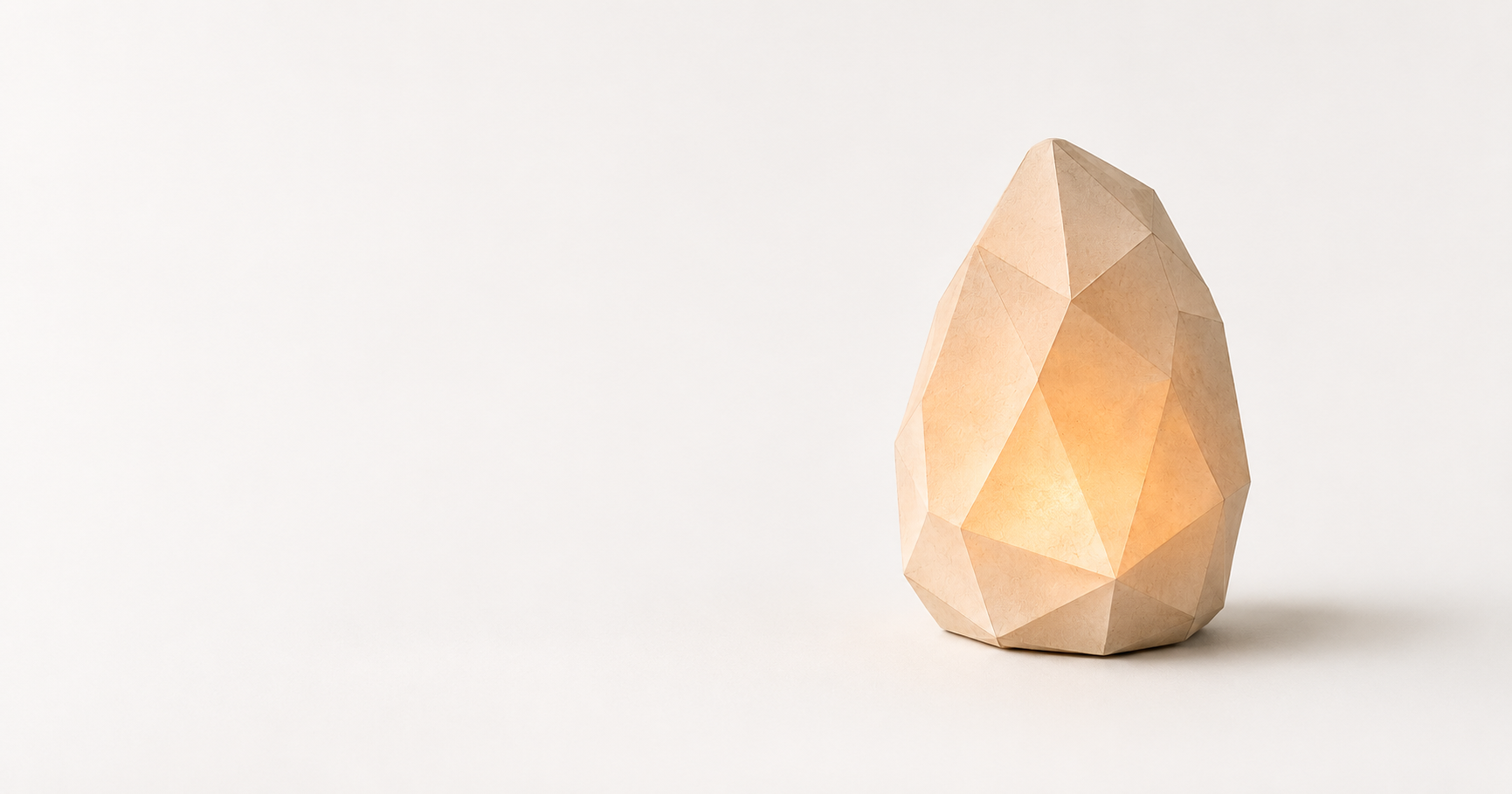
The short answer to why Himalayan salt lamps remain so popular—despite scientific studies confirming they do not purify air or release health-boosting negative ions—is that they solve an environmental psychology problem. By emitting a warm amber wavelength of light (around 1,500 to 2,000 Kelvin), a Himalayan salt lamp acts as a modern, flame-free campfire. It counters the blue light from screens, lowers nervous system arousal, and provides a clear physical signal to the brain that the workday is over and it is safe to rest.
Walk into almost any modern apartment, home office, or bedroom, and there is a high probability you will spot this familiar object: a heavy, rough-hewn chunk of pink salt sitting atop a small wooden base, glowing softly from within.
It is a fascinating artifact when you step back to look at it. We live in an era dominated by hyper-efficient smart bulbs, app-controlled LED strips, and high-tech air purifiers. Yet millions of people voluntarily buy a mass-manufactured mineral slab, plug it into a wall, and place it beside their sleek laptops or bedside tables.
Do Himalayan Salt Lamps Actually Work?
The marketing behind these lamps promises an impressive list of miracle health benefits: they claim to emit negative ions, neutralize electromagnetic radiation, purify indoor air, and cure seasonal fatigue. Science, however, has repeatedly debunked almost all of these physical claims. Under rigorous laboratory testing, a warm salt crystal releases virtually zero meaningful negative ions into a room.
And yet, despite these pseudo-scientific claims falling apart, people rarely return them. They keep them lit on their desks for hours every single night. They cherish them.
Why do we cling so strongly to an object whose literal utility is largely a myth? If the Himalayan salt lamp does not actually clean our air or shield us from electronic noise, what system of human behavior makes it feel so essential to our modern sanctuaries?
Why Do Warm Salt Lamps Make Us Feel So Calm?
To understand the enduring pull of the salt lamp, we have to look at the mismatch between our evolutionary biology and our current living environment.
For hundreds of thousands of years, the human nervous system relied on environmental cues to regulate its internal state. Daylight signaled alertness, hunting, and movement. The warm, low-intensity amber glow of campfire signaled safety, social connection, and the onset of sleep. Fire was humanity’s original environmental reset button.
Today, we have replaced the evening campfire with the cold, aggressive blue light of smartphones, laptops, and modern fluorescent bulbs. Blue light actively suppresses melatonin production, convincing our ancient brains that it is perpetually mid-afternoon. We exist in a state of chronic environmental alertness.
This is where the system of the salt lamp steps in. The true value of the lamp is not chemical or ionic; it is optical and psychological.
Philosopher Gaston Bachelard wrote in The Psychoanalysis of Fire:
“Fire gives to the man who watches it a sense of warm shelter… it invites us to a state of reverie.”
The salt lamp functions as a modern, risk-free proxy for fire. Its warm amber tone bypasses our brain’s alertness triggers. When we dim the main overhead lights and switch on a salt lamp, we are not purifying our physical air—we are altering our perceptual environment. It operates as a physical anchor that communicates directly with our mammalian biology: the workday is over, the environment is safe, you are permitted to slow down.
The wellness industry sells the lamp through the language of physical health because modern culture values utility over feeling. We feel compelled to justify our purchases with measurable benefits like “air filtration”. But what we are actually buying is a behavioral off-switch in a world that never stops buzzing.
How Did a Salt Lamp Change My Own Evening Routine?
I noticed this pattern in my own routine a few years ago. My workspace had become a battleground of open browser tabs, endless notifications, and the harsh glare of a dual-monitor setup. By late evening, even when I closed the laptop, my mind remained wired, humming at the same frequency as the digital clutter I had just left behind.
I eventually bought a Himalayan Glow Natural Salt Lamp on Amazon on a whim. I knew the negative ion claims were nonsense before I ordered it, yet the moment I cleared a space on my wooden side table and turned it on, something subtle shifted.
The lamp didn’t clean the dust in my room, but it instantly changed the emotional geometry of the space. The harsh corners of the room softened into warm shadows. The amber light didn’t demand my attention or push notifications at me; it simply occupied space quietly.
I realized then how much effort I was spending trying to force myself to relax using sheer willpower. I was trying to think my way into calm while surrounded by an environment designed for alertness. The lamp didn’t fix my stress, but it altered the container I was living in, making stillness possible.
The Evening Ambient Setup
Primary Light Anchor: Himalayan Glow 100% Natural Pink Salt Lamp
— Hand-carved Pakistani pink salt with a built-in dimmer switch for low-blue-light evening relaxation.
Bulb Complement: 15-Watt Dimmable Bulbs
— Soft 2,700K amber replacement bulbs to maintain a warm flame-like tone.
What Do Salt Lamps Teach Us About Modern Rest?
We often try to solve internal friction with internal discipline, forgetting that human behavior is heavily dictated by environmental cues.
An object doesn’t need to perform a literal, scientific miracle to have profound value in your life. Sometimes, its greatest utility lies in its symbolic power—its ability to interrupt our automated patterns and signal a transition from doing to being.
In an over-optimized, hyper-connected world, we don’t always need more function. What we desperately crave are sanctuaries—spaces and objects that permit us to drop our guard and rest.
How Are You Signaling to Your Mind That It’s Safe to Stop?
What artificial signals or environmental anchors are you currently using to tell your mind that it is okay to stop working?
Note on authenticity: If you choose to add a salt lamp to your workspace or bedroom, make sure to pick one made from genuine Pakistani pink salt with a UL-certified dimmer switch. Cheap plastic knockoffs do not emit the same warm amber frequency. The exact model referenced in this essay is the Himalayan Glow Natural Salt Lamp.

 English
  简体中文
简体中文